Rocky habitat like other “princess” lamprologins, where they form large social groups, comparable
to N. brichardi and N. pulcher.
Geographic distribution:
Northern Tanzania, north of Sibwesa, probably extending to the Lubulungu River.
In this region, princess-like species present include N. aff. gracilis and
N. savoryi. Between Ikola and the Lubulungu River, N. brichardi and
N. pulcher are reported to be absent.
Typical adult size:
Exact data unavailable; reportedly similar to N. gracilis and approximately 2 cm larger
than N. sp. “Princess Kekese”, according to African Diving Ltd.
Sexual dimorphism:
Males and females are very similar in appearance; males are slightly larger.
Recommended aquarium size:
150 L for a species-only colony. In a community aquarium, at least 300 L is recommended.
Aquarium setup:
Behaviour in aquaria is described as very similar to N. brichardi and
N. pulcher. The species rapidly forms colonies and may occupy the entire aquarium, which can
result in territorial aggression toward other cichlids; a species-only aquarium is therefore
recommended.
Provide extensive rockwork arranged to create numerous passages and caves; stacking rocks high toward
the back of the aquarium is strongly recommended.
Diet:
Carnivorous. Feeds mainly on small invertebrates such as insects and cyclops. In aquaria, accepts
quality commercial foods as well as live and frozen foods.
Breeding:
Colonial breeder, forming large groups comparable to N. brichardi and
N. pulcher. Typical brood size is reported to be about 30 juveniles.
Aggression:
Reported to be similar to N. gracilis.
Special notes:
Neolamprologus sp. 'princess lyamembe' occurs north of the range of
N. sp. 'princess kekese' and is considered by African Diving to form a “syntopic and cryptic
princess-like species pair” with N. aff. gracilis, due to their strong morphological
and colour similarities.
The population at Lumbye (about 18 km northwest of Lyamembe) has previously been identified as
N. falcicula (Konings, 1998) or N. chitamwebwai (Verburg & Bills, 2007). However,
because fishes from Lumbye lack the black fin margins typical of N. falcicula,
N. chitamwebwai, N. walteri, and N. sp. 'cygnus', and instead show a light
blue margin, the Karlsson brothers (African Diving) regard them as belonging to an undescribed species,
referred to as N. sp. 'princess lyamembe'.
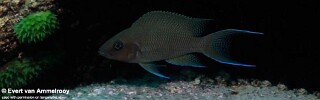
Differences versus N. sp. 'princess kekese': N. sp. 'princess lyamembe' is reported to
be about 2 cm larger, greyish beige in colour, and more elongated and elegant in body shape. In
contrast, N. sp. 'princess kekese' is described as yellowish beige, smaller, and with a deeper
body, as well as a yellowish margin on the dorsal fin. Both species have white spots on the caudal,
anal, and dorsal fins.
Juvenile colouration differs markedly: juveniles of N. sp. 'princess lyamembe' are described as
greyish, lacking yellow and orange pigmentation, whereas juveniles of
N. sp. 'princess kekese' resemble those of N. sp. 'cygnus', with bright orange markings.





Provide extensive rockwork arranged to create numerous passages and caves; stacking rocks high toward the back of the aquarium is strongly recommended.
The population at Lumbye (about 18 km northwest of Lyamembe) has previously been identified as N. falcicula (Konings, 1998) or N. chitamwebwai (Verburg & Bills, 2007). However, because fishes from Lumbye lack the black fin margins typical of N. falcicula, N. chitamwebwai, N. walteri, and N. sp. 'cygnus', and instead show a light blue margin, the Karlsson brothers (African Diving) regard them as belonging to an undescribed species, referred to as N. sp. 'princess lyamembe'.
Differences versus N. sp. 'princess kekese': N. sp. 'princess lyamembe' is reported to be about 2 cm larger, greyish beige in colour, and more elongated and elegant in body shape. In contrast, N. sp. 'princess kekese' is described as yellowish beige, smaller, and with a deeper body, as well as a yellowish margin on the dorsal fin. Both species have white spots on the caudal, anal, and dorsal fins.
Juvenile colouration differs markedly: juveniles of N. sp. 'princess lyamembe' are described as greyish, lacking yellow and orange pigmentation, whereas juveniles of N. sp. 'princess kekese' resemble those of N. sp. 'cygnus', with bright orange markings.
Photo gallery