Neolamprologus sp. 'benthosplendens' Luagala Point
Tribe / Genus:
Lamprologini / Neolamprologus
Biotope:
Lives in the intermediate habitat at great depths, never observed shallower than
40 m. Occurs where rocks are still exposed and provide shelter and breeding sites,
often close to sandy bottom. The environment is dim to very dark, which is reflected
in the species’ very large eyes. At Kekese, the rocky habitat extends to at least
60 m depth, where the species was regularly observed in caves formed by stacked
rocks.
Geographic distribution:
Restricted to the central Tanzanian shore of Lake Tanganyika; observed at Halembe,
Hapa Ingii Fara, Luagala Point, Kalugunga, Kekese, and Katondo Point.
Typical adult size:
Mature males observed in the wild reached about 10 cm total length; females about 6 cm
(pers. comm. with Mattia Matarrese, 2 Feb 2026).
Sexual dimorphism:
Pronounced. Females and juveniles have a silvery-white ground color with a strong
melanin pattern of thick vertical bars (five below the dorsal fin) and two thick
black horizontal bands. Mature males become yellow-brown, with the melanin pattern
only faintly visible, and show yellow coloration in the caudal fin and the trailing
parts of the dorsal and anal fins.
Diet:
No direct observations available; likely feeds mainly on invertebrates, as is
typical for lamprologines inhabiting the intermediate habitat.
Breeding:
A cave brooder. Juveniles smaller than 2 cm have not been observed; small individuals
believed to be females have been seen inside a pair’s cave. This suggests very
small spawns and prolonged parental association of the offspring. Behaviour is
considerably more secretive than in species such as N. pulcher.
Aggression:
No direct observations available.
Special notes:
A deep-water lamprologine discovered in 2019 by Mattia Matarrese and Tautvydas
Pangonis along the Tanzanian shore of Lake Tanganyika. It can be confused only with
N. buescheri, but differs by lacking the black submarginal dorsal-fin band and
by having a much larger eye (about 30% of head length versus 23–25% in
N. buescheri). It also differs from N. bifasciatus by its smaller eye and
much smaller adult size.
The species has extremely large eyes and shows rows of tiny whitish sensory pits
beneath the eye and on the operculum, which are believed to assist in prey detection
in very low light conditions. Although initially thought to be rare, it appears to
be relatively common below 40 m depth, but its deep habitat makes collection and
observation difficult. It has not yet been collected for the aquarium trade.
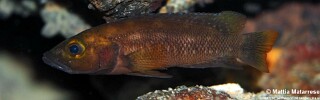
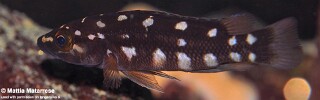
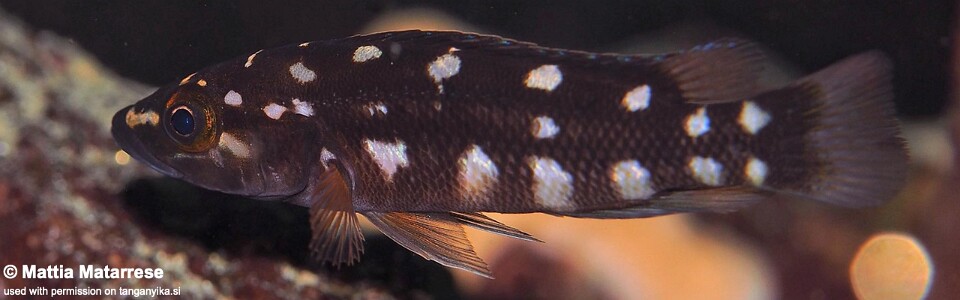



The species has extremely large eyes and shows rows of tiny whitish sensory pits beneath the eye and on the operculum, which are believed to assist in prey detection in very low light conditions. Although initially thought to be rare, it appears to be relatively common below 40 m depth, but its deep habitat makes collection and observation difficult. It has not yet been collected for the aquarium trade.
Photo gallery