Mtoto, Lake Tanganyika, Democratic Republic of Congo
Biotope:
Inhabits shallow rocky to intermediate habitats. Compared to the similar
N. tretocephalus, it mainly occupies areas with less sand.
Geographic distribution:
Occurs in the southern part of Lake Tanganyika. On the western shore it is found
south of Cape Tembwe, while on the eastern shore it occurs south of Isonga. The
distribution overlaps with N. tretocephalus on the eastern Tanzanian coast
from Isonga to Cape Mpimbwe, and on the western Congolese coast between the Livua
River and Cape Tembwe, without apparent interbreeding.
Typical adult size:
Reaches about 16 cm total length in the lake and may grow slightly larger in
aquaria.
Sexual dimorphism:
No marked differences except that males are noticeably larger than females.
Recommended aquarium size:
300 L (for a pair)
Aquarium setup:
Provide a sandy substrate with numerous shelters created by rockwork, while
leaving sufficient open space for swimming. The species lives in pairs and is
highly aggressive toward conspecifics, so even in large aquaria only a single pair
should be kept. Best maintained in a species-only tank or, in very large aquaria,
together with other robust cichlids of similar size that occupy different areas of
the tank. During spawning and parental care, the defended territory becomes very
large and is aggressively protected; outside the breeding period, aggression
toward other species is lower.
Diet:
Carnivorous; feeds on various invertebrates including insects, crustaceans and
mollusks, and occasionally on small fishes. In aquaria it accepts a variety of
live and frozen foods.
Breeding:
A monogamous species. Pairs usually remain together at least throughout parental
care and often longer. The female typically excavates a pit beneath a rock and
deposits the eggs underneath, hidden from view. Clutch size is large, around
500 eggs. Both parents guard the fry, with the female staying close to them and
the male patrolling the territory borders. Parental care lasts about four months,
after which the juveniles are expelled at a size of roughly 3 cm. During spawning,
the black vertical bars fade strongly and may be reduced to dark spots along the
mid-body. The yellow form breeds relatively easily in aquaria, while the southern
blue form is reported to be much more difficult to breed.
Aggression:
Very aggressive toward conspecifics; even in large aquaria only a single pair can
be kept.
Special notes:
Very similar to N. tretocephalus, but easily distinguished by the number of
vertical bars: N. sexfasciatus has six, whereas N. tretocephalus has
five. Several geographic colour variants are known. Blue-coloured populations
occur in the south between Moliro (DR Congo) and Kala (Tanzania). North of the
Livua River on the western shore, the upper body and head are yellow, while
populations north of Fulwe Rocks on the eastern shore are entirely yellow. All
variants share the characteristic six black vertical bars.


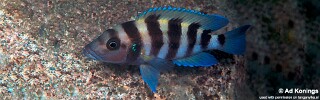



Photo gallery