Inhabits rocky habitats throughout Lake Tanganyika and can be found in almost
every rocky area around the lake, with the exception of Kombe, where the situation
is considered unusual. Occupies depths between 10 and 40 m, which is deeper than
most other princess species that are typically found between 5 and 25 m.
Geographic distribution:
Rocky shores all around Lake Tanganyika; also tolerates deep sandy bottoms when
rocks are present nearby.
Typical adult size:
In the lake up to about 7 cm total length; in aquaria slightly larger, around
8–9 cm. Females remain noticeably smaller, around 6 cm.
Sexual dimorphism:
Males and females are very similar in appearance; males are larger.
Recommended aquarium size:
100 L (for a pair)
Aquarium setup:
A calm cichlid that can be kept as a pair, or as one male with two females, in an
aquarium of about 100 L. In larger aquaria it may also be kept in a community
Tanganyika setup, where it defends a relatively small territory. Provide abundant
rockwork arranged to form many caves, use fine sand as substrate, and keep the
lighting subdued.
Diet:
Carnivorous, feeding mainly on invertebrates such as insect larvae and small
crustaceans (copepods), but among the princess species it is the most omnivorous
and also consumes small amounts of plant-derived material. In aquaria it should
be offered a variety of live and frozen foods such as krill, mysis, and cyclops.
Breeding:
A substrate spawner with loosely bonded pairs. In the lake the species is
monogamous, while in aquaria males may become polygynous. Each sex maintains its
own crevice, and the male visits the female only for spawning. The number of fry
is extremely low, usually fewer than 10, similar to N. falcicula and
N. sp. “Cygnus”. Fry and juveniles display vertical body stripes that fade
with age.
Aggression:
Relatively peaceful, but will aggressively defend its territory against other
cichlids.
Special notes:
Considered the most ancestral of the princess cichlids, giving its name to the
Neolamprologus savoryi complex. It differs from other princess species by
its darker coloration, which provides camouflage in deeper, dimly lit habitats,
and by its shorter body. Juveniles show distinct vertical barring that disappears
with age. The species is widespread throughout the lake and is highly tolerant of
different rocky environments, occasionally occurring over deep sandy bottoms near
rocks. A form referred to as N. sp. “Savoryi Fulwe” has been reported, said
to differ by a more elongated body and the absence of vertical bars.


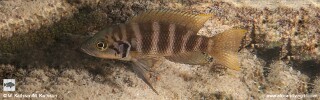



Photo gallery