Lunangwa-Fjord, ca. 110 km south of Moba, Lake Tanganyika, Democratic Republic of Congo
Biotope:
Intermediate sand–rock habitat, where the species remains
closely associated with larger rocks and boulders.
It inhabits relatively deep water, only rarely encountered
shallower than 15 m, and has been observed down to at least
45 m depth, possibly occurring even deeper.
Geographic distribution:
Restricted to a short stretch (approximately 40 km) of the
southwestern Congolese shore of Lake Tanganyika,
from a few kilometers south of Kapampa to the Lunangwa Fjord.
Outside this range the species has not been found,
while the closely related Neolamprologus pectoralis
occurs both north and south of this area.
Typical adult size:
Up to about 10 cm total length in the wild.
In aquarium conditions specimens may grow considerably larger,
reaching up to approximately 15 cm.
Recommended aquarium size:
300 liters for a group aquarium.
A formed pair can be kept in a somewhat smaller aquarium,
provided sufficient space and shelters are available.
Aquarium setup:
A sandy substrate combined with isolated rock piles
forming caves and narrow crevices.
Lighting should be subdued.
The species behaves similarly to Neolamprologus leleupi,
but grows significantly larger and therefore requires more space.
It is advisable to start with a group (as with
Julidochromis species) and later remove surplus individuals
once a pair has formed.
Because the pair bond is weak, a pair kept alone may break,
and in such cases the male may kill the female if insufficient
shelter is available.
Diet:
Carnivorous.
Feeds mainly on invertebrates, including crustaceans,
insect larvae and snails.
Breeding:
A cave spawner.
Spawning takes place inside crevices or under stones.
The pair bond is weak and males often mate with several females
in succession.
The clutch usually consists of 50 to 100 eggs.
Only the female guards the eggs and fry and often remains
inside the cave for a long time until the young become
free-swimming, while the male rarely participates in brood care.
Aggression:
Highly aggressive within the species.
Due to the weak pair bond, lethal aggression by the male
towards the female may occur in aquaria that are too small
or lack sufficient hiding places.
Special notes:
This species is probably most closely related to
Neolamprologus pectoralis, from which it differs by its
distinctive coloration, smaller maximum size, and notably
smaller pectoral fins.
In body shape and behavior it also resembles
Neolamprologus leleupi, and even more so the more slender
Neolamprologus longior.
The species has a very limited and well-defined distribution,
and despite extensive surveys by Heinz Büscher,
the descriptor of the species, it has not been recorded
outside this narrow range.

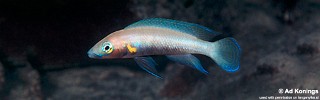



The species behaves similarly to Neolamprologus leleupi, but grows significantly larger and therefore requires more space.
It is advisable to start with a group (as with Julidochromis species) and later remove surplus individuals once a pair has formed. Because the pair bond is weak, a pair kept alone may break, and in such cases the male may kill the female if insufficient shelter is available.
The pair bond is weak and males often mate with several females in succession.
The clutch usually consists of 50 to 100 eggs. Only the female guards the eggs and fry and often remains inside the cave for a long time until the young become free-swimming, while the male rarely participates in brood care.
In body shape and behavior it also resembles Neolamprologus leleupi, and even more so the more slender Neolamprologus longior.
The species has a very limited and well-defined distribution, and despite extensive surveys by Heinz Büscher, the descriptor of the species, it has not been recorded outside this narrow range.
Photo gallery