Cape Banza, Ubwari Peninsula, Lake Tanganyika, Democratic Republic of Congo
Biotope:
Moderately deep rocky habitat. Most common at depths of about 12–15 m.
Geographic distribution:
Western Congolese coast of Lake Tanganyika, mainly from the Ubwari
Peninsula (type locality) south to Milima.
Typical adult size:
Up to about 15 cm total length. Females are several centimeters smaller
than males.
Sexual dimorphism:
No marked sexual dimorphism, except that females are smaller than males.
Recommended aquarium size:
300 L.
Aquarium setup:
Provide extensive rockwork to form many passages and caves. Keep as a
pair or as one male with several females. In sufficiently large
aquaria (300 L or more), it can be kept with other Tanganyika
cichlids that use different zones of the aquarium.
Diet:
Carnivorous. Feeds on invertebrates. In aquarium, offer live and frozen
foods.
Breeding:
Cave spawner. Ad Konings (2016) reports harem breeding, with a male
spawning with several females; the female then cares for eggs and
fry. Information on cichlidae.com differs, stating that both parents
guard the brood, with the female inside the cave and the male
guarding the cave entrance.
Aggression:
High intraspecific aggression, especially among males. Toward other
species it is described as relatively peaceful.
Special notes:
A light-bodied species typically showing two horizontal lines. It may
resemble Neolamprologus bifasciatus, but that species does
not have a crescent-shaped caudal fin. The trade name “Ubwari
Buescheri” suggests a link to N. buescheri; however,
N. longicaudatus grows larger and is reported to spend more
time outside caves than N. buescheri. The species was
described from specimens collected at Cape Banza, and Ad Konings
reports having seen it also around the Kavala islands and at
locations between the Ubwari Peninsula and Kavala.

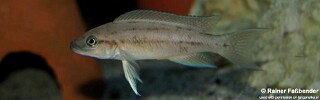


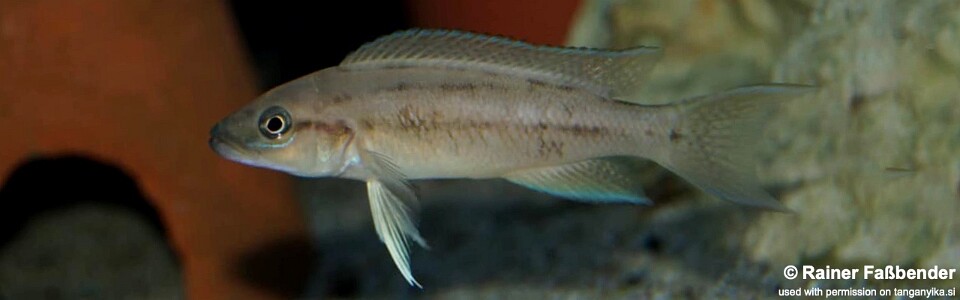



Photo gallery