Rocky habitat, where it forms large social groups similar to other
“princess” species. Recorded at depths of about 5–20 m and found in
the same general habitat as other members of the complex, including
Neolamprologus savoryi and one or another member of the
brichardi–pulcher superspecies. It is also reported to occur
sympatrically with N. marunguensis, which is very similar in
coloration but differs in body shape.
Geographic distribution:
Reported from the Congolese coast between the Lunangwa River and Kanoni.
The species is also reported from Lumbye on the Tanzanian coast.
North of Sibwesa on the Tanzanian coast, additional similar “princess”
forms are mentioned, including Neolamprologus sp. “Princess
Lyamembe” and Neolamprologus sp. “gracilis tanzania”, while
farther south (Ikola to Isonga) another colonial “princess” form is
noted as Neolamprologus sp. “Princess Kekese”.
Typical adult size:
Reaches about 7 cm not counting the caudal-fin extensions; total length
exceeds 10 cm when the fin extensions are included.
Sexual dimorphism:
Sexes are externally very similar; males are on average slightly larger
and tend to have a less rounded belly.
Recommended aquarium size:
150 L for a species-only colony. In a community aquarium, at least
300 L is recommended.
Aquarium setup:
Arrange extensive rockwork to create many caves and passages, with rocks
ideally stacked high toward the back of the aquarium. The species
behaves similarly to N. brichardi and N. pulcher,
but remains smaller. It quickly forms a colony and may occupy the
entire aquarium, reducing space available to other fishes and
increasing territorial conflicts; a species-only aquarium is therefore
strongly recommended. If kept in a community setup, a much larger
aquarium is required.
Diet:
Carnivorous. Feeds mainly on small invertebrates such as insects and
copepods. In aquaria, provide quality commercial foods supplemented
with live and frozen items.
Breeding:
A colonial breeder that forms sizeable family groups, similar to
N. brichardi and N. pulcher. Colony structure and
the extent of group living are described as influenced by population
density and the species’ comparatively lower intraspecific aggression.
In aquaria, prolific reproduction can lead to rapid expansion across
the tank, and excess young may need to be removed while retaining
some helpers for territorial defense.
Aggression:
Can be quite aggressive toward conspecifics, though generally less so
than N. brichardi and N. pulcher.
Special notes:
Neolamprologus gracilis is often compared with
N. marunguensis due to very similar coloration, but the two
occur together at the same localities and differ markedly in shape.
N. gracilis is described as one of the most elegant “princess”
species, with exceptionally long caudal-fin extensions—longer than
in any other member of the complex—and a distinctive sky-blue iris.
It lacks the black facial markings seen in some other “princess”
species, but shows a bright blue line beneath the eye.


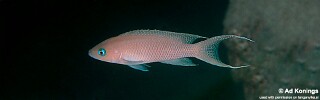



Photo gallery