Predominantly sandy habitats. Occurs from shallow water down to deeper sandy zones,
recorded at depths of approximately 5 to 75 meters.
Geographic distribution:
Endemic to Lake Tanganyika and found along the shores throughout the lake.
Typical adult size:
Adult males reach about 12 cm total length in the lake, while females remain slightly
smaller; in captivity males may attain up to about 14 cm.
Sexual dimorphism:
Breeding males develop a blue body and dorsal fin, a black throat, and yellow pelvic fins.
Females and non-breeding males are silvery, with only the upper half of the iris yellow. Adult males
are typically 1–2 cm larger than females, while females and subadult males are otherwise difficult
to distinguish.
Recommended aquarium size:
At least 150 L; due to its active swimming behavior, a tank length of roughly 125 cm is
recommended.
Aquarium setup:
The aquarium should have a bottom of fine sand, with a few scattered rocks placed on the
sand. This is a relatively peaceful species and should not be kept with aggressive or highly
territorial cichlids. As a schooling fish in nature, it is best maintained in groups of at least
six individuals.
Diet:
Omnivorous microphage. Feeds mainly on algae, diatoms, cyanobacteria, and other
microorganisms collected from the sand and water column. Stomach content analyses revealed mostly
sand grains mixed with microorganisms, diatoms, blue-green algae, and bacteria.
Breeding:
Maternal mouthbrooder. Males construct large sand-scrape bowers, consisting of a circular
wall around a shallow crater, often about 40–50 cm in diameter. Spawning takes place in the center
of the crater, where eggs are fertilized on the sand before the female collects them into her mouth.
In captivity females may produce broods of about 60–70 fry, which are released after the brooding
period and not taken up again.
Aggression:
Moderately aggressive, mainly associated with breeding and territorial behavior.
Special notes:
A true sand-dwelling species with excellent camouflage and escape behavior. The silvery
body reflects the sandy substrate, making individuals difficult for predators to single out. When
threatened, it can rapidly dive into the sand and completely bury itself for several minutes. The
taxonomic status relative to Lestradea stappersii has been debated historically, but Lestradea
perspicax is currently treated as a distinct species.


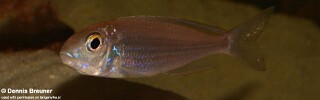



Photo gallery