Shallow, sediment-rich rocky to intermediate habitats; also found above soft sandy or muddy
substrates close to the shore (reported down to about 40 m).
Geographic distribution:
Northern Lake Tanganyika; documented from Burundi and other northern localities, generally
considered to occur in the northern quarter of the lake (north of the Ubwari Peninsula), with records also
indicating presence north of Nyanza-Lac on the eastern side.
Typical adult size:
Up to about 11 cm total length; sources also cite a maximum of 12 cm.
Sexual dimorphism:
Sexes look alike; males are larger than females.
Recommended aquarium size:
120 L for a pair (provided the pair is already formed). For a community setup, at least
300 L is recommended.
Aquarium setup:
Use fine sand as the substrate and provide plenty of rocks arranged into small territories.
The species has been exported mainly from the Bujumbura area (Burundi) and has been present in the hobby for
decades but never became widely popular, likely because it lacks the striking behavior of larger congeners and
does not benefit from the very small size of shell-dwelling dwarfs. It can be housed with most other carnivorous
Lake Tanganyika cichlids; avoid keeping it with members of the same genus due to possible hybridization and
dominance issues.
Diet:
Carnivorous predator. In nature it preys on small animals, including small fishes, and
often takes fry of other species (frequently shell-dweller fry). In the aquarium it accepts quality prepared
foods, frozen foods such as krill, and fish flesh.
Breeding:
Substrate spawner that breeds among rocks; smaller individuals may also use shells as
shelter. Males are often polygynous and defend a small set of stones as a territory. Eggs are not fully hidden
and are laid on a rock (or sometimes a shell), typically around 50. After hatching, the larvae may be moved to
a shallow excavation in the sand and are cared for by the female.
Aggression:
Can be quite aggressive toward tank mates. As a predator it will also target smaller fish
and fry.
Special notes:
Very similar to Lepidiolamprologus attenuatus; distinctions reported include body shape
(pleuromaculatus typically stockier with a blunter snout) and stronger fin markings. It has been distinguished
from attenuatus by a higher scale count in the longitudinal series (over 60, reported 66–73) and a higher number
of gill rakers/branchiospines (reported 13–17 versus under 12). It has also been noted that some Congolese-coast
populations appear more slender and may represent a different, related taxon.
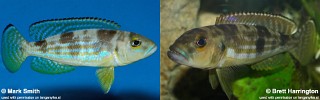
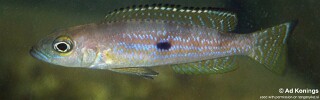



Photo gallery