Chituta Bay, Zambia, at Chituta Bay cliffs, at 10–15 m depth along the rocky slope (approximate coordinates: 08°43.82 S, 31°09.41 E), Lake Tanganyika.
Biotope:
Rocky and intermediate habitats, from very shallow water (around 5 m)
down to depths of about 50 m.
In the same areas, Lepidiolamprologus kendalli, L. elongatus, L. attenuatus,
and L. profundicola are commonly found as well.
Geographic distribution:
Zambian coast of Lake Tanganyika from Cape Nangu to Cape Kapembwa.
The species is also documented from Tanzania, where it occurs around Kipili
and Fulwe Rocks.
Typical adult size:
Up to about 18 cm total length.
Sexual dimorphism:
No visible differences between sexes, except that males are larger.
Recommended aquarium size:
500 L (a tank length of 2 m is recommended).
Aquarium setup:
The species is present in the aquarium hobby, but it has often been exported
under the names “profundicola yellow” and “profundicola tanzania”.
Use a setup similar to that used for Lepidiolamprologus elongatus and
L. profundicola: provide many rocks and a sandy bottom.
Because it likes to dig, place rocks directly on the tank bottom (not on the sand)
to prevent rock falls and possible glass damage.
It can be kept with other Lake Tanganyika cichlids, but tank mates must not be too small,
otherwise they may become prey.
Diet:
Carnivorous predator.
Its preferred food is young fish of other cichlids (in the lake mainly Cyprichromis).
In the aquarium, offer live and frozen foods (fish, crustaceans, and similar items).
Breeding:
It breeds similarly to Lepidiolamprologus kendalli in intermediate habitats,
but in shallower water.
A difference between the two species is that in L. kendalli both parents guard the fry,
while in L. mimicus the fry are guarded only by the female.
The number of fry is usually high (about 500 to 1000).
Aggression:
Aggressive mainly within its own species.
It can also be aggressive toward other species, especially during reproduction.
Special notes:
Besides Plecodus straeleni (which mimics Cyphotilapia),
Lepidiolamprologus mimicus shows a different but fascinating form of mimicry.
It has a body shape similar to Cyprichromis, and juveniles and females have a yellow anal fin,
which allows them to approach large schools of Cyprichromis and even mix among them,
making those fish easy prey.
Over time, this mimicry fades: the yellow anal-fin coloration disappears,
and the fish becomes increasingly recognizable (and also much larger than Cyprichromis).
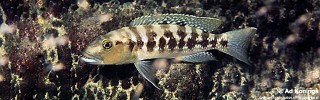

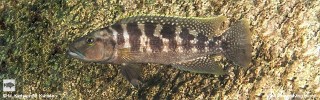
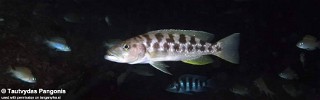
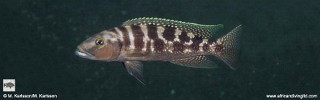



Photo gallery