Northwest of Mutondwe Island, Lake Tanganyika, Zambia.
Biotope:
Rocky habitat, occurring in shallow water as well as at depths greater than 45 m.
It is also found in intermediate habitat, but still in the vicinity of rocks.
Geographic distribution:
From eastern Zambia (Nkamba Bay) to Kala, southern Tanzania.
Typical adult size:
Males reach 22 cm total length.
Females are about 25% smaller.
Sexual dimorphism:
No visible differences other than size, with males being markedly larger.
Recommended aquarium size:
500 L (recommended length 200 cm).
Aquarium setup:
Use many rocks to create numerous passages and caves.
The aquarium must have a lid and all openings should be closed,
as the fish can jump out even at a relatively small size.
Keep either a pair or a single specimen.
Intraspecific aggression is extreme, and if more than a pair is kept
they will very likely kill each other.
When buying juveniles, it is recommended to start with about six fish,
and separate the rest once a pair forms.
Suitable tank mates (in a sufficiently large aquarium) are other carnivorous
Tanganyika cichlids large enough not to be taken as prey
(e.g., Altolamprologus, Chalinochromis).
Diet:
Carnivorous predator, feeding mainly on smaller cichlids.
In aquarium, provide a high-protein diet and offer meaty frozen foods
such as fish, krill, and similar.
Breeding:
Based on observations in the natural habitat, it prefers to breed in deeper water
in the intermediate habitat.
Eggs are laid on an open site, as in other larger Lepidiolamprologus,
because it is strong enough to defend them in exposed locations.
Both parents defend eggs and fry, as is typical for other Lepidiolamprologus
(except L. mimicus and L. profundicola).
Clutch size is noticeably smaller than in L. elongatus,
but can still exceed 500 eggs.
In the aquarium, the female may become aggressive toward the male after spawning
and chase him away; this is presented as reflecting lake behavior where the female
defends the area closest to the eggs while the male defends the outer territory.
Aggression:
Very aggressive, especially toward conspecifics.
Aggression toward other species increases notably during fry defense.
Special notes:
Resembles Lepidiolamprologus elongatus in body shape and coloration,
but is easily distinguished by having the pattern on the head,
which L. elongatus lacks.
In the lake it is much rarer than L. elongatus and is usually encountered alone,
moving through the habitat and searching for prey.
The geographic variant known as “Black Nkambae”, previously treated as
Lepidiolamprologus nkambae, is stated to be a junior synonym of L. kendalli;
DNA analyses are cited as showing that the Nkamba Bay population does not differ
from other L. kendalli populations.
It is described as morphologically indistinguishable from Lepidiolamprologus kamambae,
but differing slightly in coloration and in habitat association:
L. kamambae is linked to the rock–sand transition above sandy bottom,
while L. kendalli is associated with rocks with dark caves.
Despite this close similarity, Lepidiolamprologus kamambae is currently treated
as a valid species.

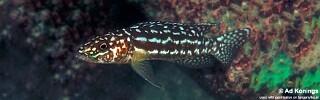



Photo gallery