Intermediate habitat over sandy to rocky substrates,
mainly in shallow waters down to about 25 m depth.
Usually encountered in pairs or small loose groups.
Geographic distribution:
Circum-lacustrine distribution around Lake Tanganyika.
Absent north of the Ubwari Peninsula,
where it is probably replaced by Lepidiolamprologus pleuromaculatus.
Typical adult size:
Males up to about 14–15 cm total length.
Females smaller, usually reaching around 10 cm.
Sexual dimorphism:
Limited.
Males are larger than females,
otherwise no clear differences in coloration or shape.
Recommended aquarium size:
150 L for an established pair.
At least 300 L recommended for a community aquarium.
Aquarium setup:
Fine sand substrate combined with extensive rockwork
forming caves, passages, and vertical surfaces.
Avoid keeping together with other Lepidiolamprologus species
due to the risk of hybridization.
Tankmates should be robust Tanganyika cichlids
large enough not to be considered prey.
Diet:
Carnivorous predator.
Feeds on small fishes and various invertebrates.
In the aquarium accepts meaty foods such as krill,
shrimp, fish flesh, and high-quality frozen foods.
Breeding:
Substrate spawner.
The pair excavates a nest in sand near rocks.
Eggs are laid on vertical rock faces
and remain visible from the outside.
Clutch size usually ranges from 150 to 250 eggs.
Both parents guard eggs and fry.
Free swimming occurs after about 5 days,
and parental care continues for 8–12 weeks
until juveniles reach about 3–3.5 cm.
Aggression:
Moderate to high,
especially during breeding.
Can be aggressive toward tankmates and conspecifics.
Special notes:
An extremely slender species with more than 60 scales
in the longitudinal series and a low body height.
Characteristic black blotch on the flank.
Closely related to Lepidiolamprologus pleuromaculatus
and to the shell-dwelling form known as
Lepidiolamprologus sp. ‘meeli Kipili’,
which may represent an ecotype or local variant.


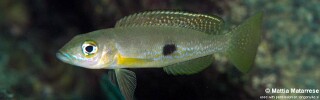



Photo gallery