South of M'Toto in front of Moba, 1 km offshore, Lake Tanganyika, Zaire.
Biotope:
Occurs in deeper water, typically around 30–45 m, over muddy bottom where only few snail shells are present.
Females live in small gastropod shells, usually not Neothauma, but shells of Paramelania and Lavigeria,
which are smaller than Neothauma shells. Males are too large to live inside these shells and instead control a territory
containing the females’ shells.
Geographic distribution:
Found along the shores of Lake Tanganyika. Southernmost populations, mainly from Zambia,
are considered to represent a different species (Lamprologus sp. "ornatipinnis Zambia").
Typical adult size:
Males reach up to about 9 cm in total length, while females remain much smaller, around 3 cm.
Sexual dimorphism:
Males are much larger than females and show slightly more extended fins.
Recommended aquarium size:
100 L
Aquarium setup:
Provide a fine sand substrate with gastropod shells placed on top.
The species is best kept as a harem, with one male and three to four females.
Females require shells as refuge and spawning sites, while males remain outside and guard the territory.
Diet:
Carnivorous. Feeds on small invertebrates and zooplankton, especially small crustaceans.
In the aquarium offer a variety of live and frozen foods.
Breeding:
Spawning takes place inside the female’s shell.
The female deposits the eggs in the shell, and the male fertilizes them from the outside by releasing milt at the shell entrance,
as he is typically too large to enter the small shells used by females.
Clutch size is limited, typically around 10 to 20 young.
Aggression:
Males can be quite aggressive toward conspecific males.
Toward other species, aggression is mainly displayed during defense of the shell territory;
otherwise they are not generally aggressive.
Special notes:
In the aquarium trade, fish sold for years as Lamprologus ornatipinnis are often actually
Lamprologus sp. "ornatipinnis Zambia", while true Lamprologus ornatipinnis is much rarer.
Compared to the Zambian form, this species is characterized by more intensely ornamented fins
and a complete edging pattern around the caudal fin.
Sexual size dimorphism is extreme: males are far larger than females, and males do not normally share shells with females.
Females typically occupy smaller Paramelania and Lavigeria shells, which also distinguishes them from the Zambian form,
which is associated with Neothauma shells.


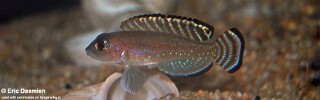



Photo gallery