tanganyika.si

Lake Tanganyika cichlids — species, locations & maps

Lake Tanganyika cichlids — species, locations & maps
By genera By locations Locations Maps Posters Interactive map
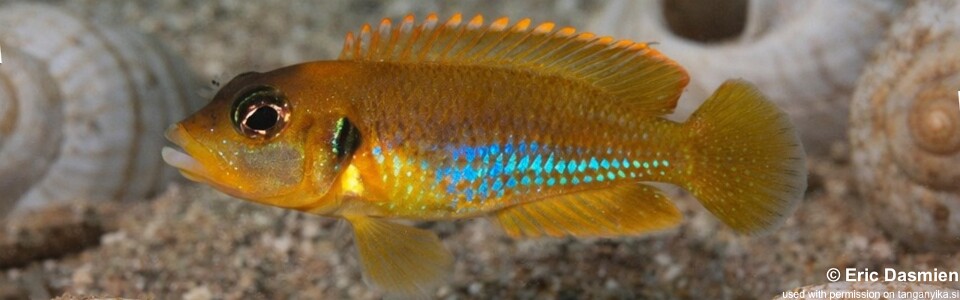
Lamprologus ocellatus 'Chimba'.jpg Lamprologus ocellatus 'Chisanse'.jpg Lamprologus ocellatus 'Gold'.jpg Lamprologus ocellatus 'Ikola'.jpg Lamprologus ocellatus 'Isanga'.jpg
Previous pageNext pageLamprologus ocellatus (Gold)
Tribe / Genus: Lamprologini/Lamprologus
Type locality: Lake Tanganyika.
Biotope: Shell-dwelling habitat. This species primarily inhabits areas with a low density of snail shells, typically between one and five shells per square meter. It is most often found in shallow waters, where each adult occupies its own snail shell. The substrate is usually sandy or muddy, which allows shells to be buried and concealed from predators, leaving only the shell opening visible. Fine sand and mud also enable individuals to rapidly bury themselves completely in the substrate when shells are not immediately available, remaining motionless until danger has passed. Although less common, the species can also occur on coarser substrates, where complete concealment of shells is more difficult.
Geographic distribution: Almost lake-wide distribution in Lake Tanganyika. It is absent from the Congolese western shoreline between Kalemie and Moliro, where its ecological niche is occupied by Lamprologus speciosus and Lamprologus stappersi.
Typical adult size: Males rarely exceed 6 cm in total length, with most adult males measuring around 5 cm. Females are distinctly smaller, reaching approximately 75% of the male’s size, around 4 cm.
Sexual dimorphism: Males are larger and usually less intensely colored than females. Females ready to spawn show a darker body coloration with a shimmering violet-blue sheen on the flanks, and the abdomen is fuller, sometimes with a yellowish tinge.
Recommended aquarium size: 60 L
Aquarium setup: The aquarium should have a fine sand substrate with several empty snail shells placed on top, at least one shell per fish. When shells are unavailable, individuals may bury themselves in the sand as an escape response. Males typically live in harems with two to three females, and both sexes inhabit shells. Males defend their territory very aggressively and may confront much larger cichlids. A male’s territory usually includes two shells reserved for himself, buried in the sand with open entrances, providing rapid access for retreat. Additional shells are completely buried and prepared for females, allowing the male to control which females may settle on his territory. Females are also aggressive and often prevent other females from joining the harem. New females most commonly enter the territory after spawning has occurred, when the resident female is occupied with brood care. Suitable tankmates in sufficiently large aquaria include other small Tanganyikan cichlids that occupy different zones of the tank, such as small Julidochromis species. Large predators should be avoided, as they may prey on these small cichlids.
Diet: Carnivorous. In the lake the diet consists mainly of chironomid larvae, small crustaceans such as shrimp, and drifting zooplankton. In the aquarium they readily accept live or frozen foods such as mosquito larvae, Artemia, Daphnia, and Cyclops.
Breeding: Both males and females occupy snail shells and the species is a cave-brooder. Males defend a sandy territory of roughly one square meter containing several shells, one used as the male’s home and others buried for potential females. A female must first gain the male’s attention before being allowed to occupy a shell on his territory. Spawning occurs inside the female’s shell. The female lays 10 to 20 eggs along the inner whorl of the shell, after which the male fertilizes them either by entering the shell or by releasing sperm into the shell opening if he is too large to enter. After spawning, all parental care is provided by the female. She guards the shell entrance aggressively and repels all intruders, including the male. Eggs hatch after about 3 days, and the fry become free-swimming after 5–7 days. Fry remain close to the shell and are fiercely defended by the female. Juveniles may remain within the male’s territory for more than two months, occupying smaller available shells, before eventually being driven away.
Aggression: Despite its small size, this is a highly aggressive species. Individuals defend their shell territories vigorously and will readily challenge much larger cichlids. Aggression is also pronounced within the species.
Special notes: Lamprologus ocellatus, Lamprologus speciosus, and Lamprologus stappersi occupy very similar habitats characterized by low shell density. Lamprologus ocellatus is the most widespread of the three and occurs almost throughout the lake, except for the Congolese western shoreline between Kalemie and Moliro. The species is characterized by a rounded caudal fin, reduced or absent scales on the neck and breast, and a strong association with fine sand or mud substrates. Females guarding fry display exceptionally bold defensive behavior and may attack objects or animals approaching their shell.

Photo: © Eric Dasmien
Photo: © Grigorij Gatih
Photo: © isabi.de
Photo: © M. Kwolek-Mirek
Photo: © Mirko Bakovic
Photo: © Tomas Zrust
tanganyika.si
Lake Tanganyika cichlids — species, locations & maps.
All images are used with permission of the authors. Unauthorized use is prohibited.
Quick links
By genera By locations Locations Maps Posters Interactive map
Contact
Email Facebook Instagram
© tanganyika.si