Near Bwassa (7°25′ S, 30°10′ E), approximately 65 km south of Moba, Lake Tanganyika.
Biotope:
Shell-dwelling habitat. This species primarily inhabits areas with a low density of snail shells,
typically between one and five shells per square meter. It is mainly found in shallow waters,
where each adult occupies its own shell.
The substrate is usually sandy or muddy, allowing shells to be buried and hidden from predators,
with only the shell opening remaining visible.
Sandy substrates also allow individuals to bury themselves completely in the sand in case of danger
when shells are not immediately available.
The species is also occasionally found on coarser substrates, where shells are more difficult to completely conceal.
Geographic distribution:
Known from the southern part of Lake Tanganyika, with confirmed records from the area around Bwassa,
south of Moba.
Typical adult size:
Males reach a maximum total length of about 6 cm, with most individuals around 5 cm.
Females are slightly smaller, reaching approximately 4 cm.
Sexual dimorphism:
Males are slightly larger than females.
Recommended aquarium size:
60 L
Aquarium setup:
The aquarium should have a fine sand substrate with several snail shells placed on top,
at least one shell per fish.
If shells are lacking, these cichlids may bury themselves in the sand when threatened.
Males typically live in harems with two to three females, and both males and females inhabit shells.
Males defend their territory very aggressively and may confront much larger cichlids.
A male’s territory usually contains two shells reserved for himself, buried in the sand but with open entrances,
providing quick access for escape. Additional shells within the territory are completely buried and prepared for females.
Females may also be aggressive and often prevent additional females from joining the harem.
New females most commonly enter the territory after spawning has occurred, when the resident female is occupied with brood care.
Suitable tankmates in sufficiently large aquaria include other small Tanganyikan cichlids that occupy different zones,
such as small rock- or cave-dwelling species like Julidochromis.
Larger predators should be avoided, as they would quickly prey on these small cichlids.
Diet:
Carnivorous. The diet consists mainly of insect larvae and various small invertebrates,
with plankton taken occasionally.
In the aquarium they readily accept Artemia, Daphnia, and Cyclops.
Breeding:
If a female is not already part of a male’s harem, spawning can only occur after she gains the male’s attention
and is allowed onto his territory, at which point the male uncovers one of the buried shells for her.
Spawning begins when the female entices the male to her shell.
The female enters the shell and lays the eggs; immediately after she exits,
the male enters the shell to fertilize the eggs, or, if too large to enter, releases sperm into the shell.
After spawning, all parental care is carried out by the female.
She positions herself at the shell entrance and aggressively drives away all intruders, including the male.
Clutch size usually ranges from 10 to 20 eggs.
The larvae hatch after approximately 3 days, and the fry become free-swimming 5–7 days later.
At this stage they begin to leave the shell briefly but remain close to it.
Females defend the fry very aggressively.
Fry remain within the male’s territory for about two months, usually sheltering in smaller shells
that are inaccessible to adults. After this period, the male expels them from his territory,
forcing them to find shelter elsewhere.
In aquaria with multiple males, fry often fall prey to males from neighboring territories.
Aggression:
Despite its small size, this is a highly aggressive species.
Individuals defend their shell territories fiercely and will readily confront much larger cichlids.
Aggression is also pronounced within the species.
Special notes:
Lamprologus meleagris inhabits similar low-shell-density environments as Lamprologus ocellatus
and Lamprologus speciosus and may occur sympatrically with L. speciosus,
although it generally occupies slightly shallower waters.
The species was described based on material collected near Bwassa.
It is characterized by a compact body shape and a reduced number of scales compared to most other lamprologines.
A closely related taxon, Lamprologus stappersi, was described from the Sambala River near Moba,
approximately 70 km away.
Ad Konings considers L. meleagris and L. stappersi to represent a single species,
interpreting their differences as geographic variation and therefore uses the name L. stappersi,
which was described earlier.
In contrast, Heinz Büscher regards L. meleagris as a distinct species,
although this remains difficult to confirm, as L. stappersi has never been rediscovered
after its original description based on a single specimen.
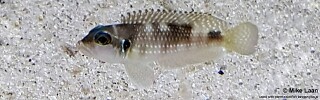


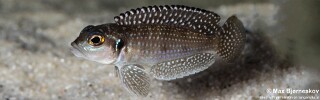



Photo gallery