Lamprologus kungweensis inhabits exclusively muddy substrates of Lake Tanganyika. It is found at depths ranging from approximately 10 to 50 meters.
Shells of the gastropod Neothauma may be present in this habitat, but they are usually occupied by other shell-dwelling cichlids.
This species naturally reproduces by digging burrows in the mud, rather than relying primarily on snail shells.
Geographic distribution:
Occurs in the northern part of Lake Tanganyika, from Kungwe Bay in Tanzania to the area around Kalemie in the Democratic Republic of Congo.
Typical adult size:
Males reach a total length of up to about 7 cm, while females remain significantly smaller, reaching approximately 3 cm.
Sexual dimorphism:
Males are larger than females. This species is unusual among lamprologines in that females are more vividly colored than males.
Females exhibit a yellow-beige body coloration with an orange to coppery belly and a distinct black-and-white marking on the dorsal fin.
Males are more uniformly colored, generally grayish, and the dorsal fin marking is weakly developed or absent.
Recommended aquarium size:
60 L (for a pair)
Aquarium setup:
The aquarium should have a fine sand substrate. Snail shells may be provided on the sand as potential spawning sites,
although this species is not a typical shell-dweller. In nature it breeds in burrows dug into muddy substrate,
and in aquaria spawning may also occur in PVC tubes that mimic these burrows.
Due to their small size, they should not be kept with larger or aggressive cichlids, especially aggressive shell-dwellers
such as species from the Lamprologus ocellatus group, which tend to monopolize shells.
They are best kept either in a species-only aquarium or together with small, peaceful Tanganyikan cichlids
that occupy different areas of the tank, such as species of the genus Paracyprichromis.
Diet:
Carnivorous. They primarily feed on zooplankton and small invertebrates such as copepods.
In the aquarium they readily accept foods such as Artemia, bloodworms, and Daphnia.
Breeding:
Breeding takes place inside burrows excavated in muddy substrate. These burrows typically have a funnel-shaped entrance,
followed by an oblique tunnel up to about 12 cm deep and approximately 1.5 cm in diameter.
The species is monogamous, but the male and female each maintain their own burrow.
Individual burrows are spaced on average about 50 cm apart.
If available and not occupied by other shell-dwellers, empty snail shells may also be used as shelter.
Spawning occurs in the female’s burrow. The eggs are non-adhesive, which is unusual among substrate-spawning lamprologines.
After egg deposition, the eggs are often transported to the male’s burrow, which is usually larger and wider.
Development from eggs to free-swimming fry takes approximately 7 days.
Brood size is usually small, up to about 15 fry.
Aggression:
Males can be quite aggressive toward conspecifics when defending their territory.
Special notes:
Lamprologus kungweensis, together with L. signatus and L. laparogramma, forms a group of very closely related species
that differ mainly in coloration. In the past, it was proposed that these three taxa might represent a single species,
but they are now generally regarded as distinct based on consistent differences, particularly in coloration.
This species is especially attractive to aquarists due to its small size and interesting behavior.
Although considered hardy, it is easily outcompeted by larger or more aggressive cichlids.
In the wild, it is a specialist of muddy sublittoral habitats, a biotope that is widespread but often overlooked in Lake Tanganyika.
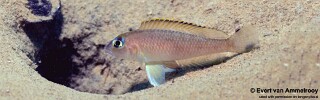
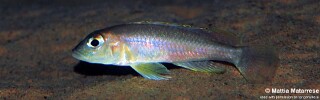



Photo gallery