Mpala and Niamkolo (Mpulungu), Lake Tanganyika, Zambia.
Biotope:
Lamprologus callipterus is a shell-brooding species in which only the female lives inside a snail shell. Males usually occur in large groups that provide
protection and inhabit the intermediate habitat. If males are not in groups, they require shelter, which is typically provided by caves among rocks.
This is also the reason why females of this species usually inhabit shells that are close to rocky environments or in intermediate habitats,
but always near rocks.
Geographic distribution:
Lamprologus callipterus is one of the most widespread cichlids of Lake Tanganyika and is encountered at every dive site.
Typical adult size:
Males grow to around 15 cm in total length, while females average about 5 cm, with a maximum size of approximately 6 cm.
Sexual dimorphism:
The most obvious difference between the sexes is the extreme size disparity. However, not all males are easily distinguished,
as this species also exhibits dwarf males that grow even slightly smaller than females (around 4 cm) and share the same coloration as females,
making them very difficult to distinguish from adult females.
Recommended aquarium size:
100 L (for one male with 5–6 females)
Aquarium setup:
The aquarium should contain some rocks that provide shelter. The substrate should consist of fine sand, with snail shells placed on top.
At least 5–6 females should be kept per male (in nature, some males live with up to 30 females).
They are suitable for a community aquarium and can also be kept together with other Tanganyikan cichlids,
although the male will actively defend his shell territory against intruders.
Diet:
Omnivorous. In Lake Tanganyika they primarily feed on various crustaceans. Because crustaceans are often difficult to locate in their habitat,
large groups—sometimes exceeding 100 individuals—allow them to disturb the substrate while moving through it, making prey easier to capture.
In addition to crustaceans, they also feed on the fry of substrate-spawning cichlids.
Their foraging groups are sometimes joined by Gnathochromis pfefferi and subadult Lepidiolamprologus elongatus,
which benefit from easier access to food.
In the aquarium they accept all foods, with an emphasis on live and frozen foods such as Cyclops, Artemia, and Daphnia.
Breeding:
When a male is ready to spawn, he leaves the foraging group and begins searching for a suitable site to establish a shell territory.
He usually starts with a small number of shells, often abandoned by another male, and transports them to his chosen location.
Because the number of suitable shells is limited and competition among males is intense, only a few—typically the strongest—males
are able to secure a territory.
The territory is usually established near rocks and may consist of 100 or more shells. During territory construction,
males sometimes steal shells from neighboring territories, occasionally transporting a female inside a shell and thereby stealing her as well.
If a male takes over another male’s territory, he will consume fry that are not his own, as they do not carry his genes.
A male typically maintains a harem of more than ten females.
When a female is ready to spawn, she entices the male near her shell. The female deposits the eggs inside the shell,
and the male fertilizes them from outside by releasing sperm into the shell opening, as males are too large to enter the shell.
Males often spawn with multiple females, and while some females wait for the male, dwarf males may take advantage of this situation
by entering the shell and fertilizing some of the eggs. Brood size usually ranges from about 35 to 160 fry.
The female guards the fry for approximately two weeks after they become free-swimming, after which she leaves the territory
to find a new shell elsewhere to recover. Fry remain within the shell territory until they reach about 2 cm in length,
after which they also leave the area.
Aggression:
Relatively peaceful cichlid. However, males will regard smaller fish as potential prey.
Special notes:
This species is one of the most fascinating Tanganyikan cichlids and could be described as a collector or thief of snail shells.
Males are large enough (up to 15 cm) to carry shells effortlessly, while females are significantly smaller, reaching at most about 6 cm.
This results in an extreme size-based sexual dimorphism. Most males are large, but the presence of dwarf males that do not exceed 4 cm
represents a unique example of male size polymorphism among Tanganyikan cichlids. Females grow to normal size regardless of whether their eggs
were fertilized by a normal-sized male or a dwarf male, whereas the size of male offspring depends on the male that fertilized the eggs.
Males often tolerate other species within their territories, most commonly Telmatochromis vittatus.
These are likely tolerated because they serve as a first line of defense against predators, which tend to attack T. vittatus before
the fry of Lamprologus callipterus. However, this coexistence also has a downside, as T. vittatus may prey on eggs and fry inside the shells
during periods of food scarcity.

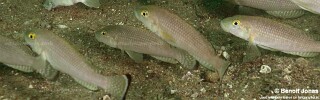



Photo gallery