Known from the western coast of Lake Tanganyika, around Kapampa,
including Nkorosha to the north and Kazia to the south.
This distribution may be extended according to the status which would be given
to the numerous populations found along the western Congolese coast.
Typical adult size:
7–8 cm total length
Sexual dimorphism:
No clear sexual dichromatism. Males are usually slightly larger than females.
Recommended aquarium size:
200–300 liters for a group; established pairs may be kept in smaller aquaria
Aquarium setup:
Rocky to intermediate setup with fine sand substrate and numerous crevices
and shelters. Territories are defended intensely, and visual barriers are essential.
Diet:
Invertebrate feeder. Small animals are picked from algal cover and rock crevices.
Accepts a wide range of aquarium foods, including flakes, pellets, and small crustaceans.
Breeding:
Breeding occurs throughout the year. Monogamous pairs are typical, though polygyny
may occur occasionally. Clutch size varies from a few eggs to several dozens.
Older juveniles may remain temporarily within the parental territory as satellites.
Aggression:
High intraspecific aggression. Territorial and intolerant toward similar-sized
lamprologines unless sufficient space and structure are provided.
Special notes:
Apart from its geographical origin on the central Congolese coast, no reliable
diagnostic features have been identified to date. Morphologically, this species
appears indistinguishable from Julidochromis ornatus from Zambia or
Julidochromis transcriptus from the northern Democratic Republic of the Congo.
Two phenotypes are described: an “ornatoid” form with more irregular longitudinal
stripes, and a “transcriptoid” form with a less checkered melanic pattern.
Color pattern and the amount of yellow pigmentation are strongly influenced by
environment and light conditions.
Many authors recognize numerous ornatus–transcriptus-like populations around the lake,
but clear species boundaries remain unresolved. Pending further research, the Kapampa
population — including nearby localities such as Nkorosha to the north and
Kazia to the south — is treated here as a distinct, undescribed species.
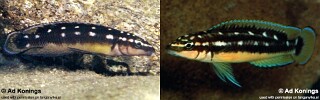
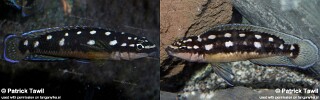
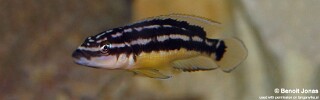
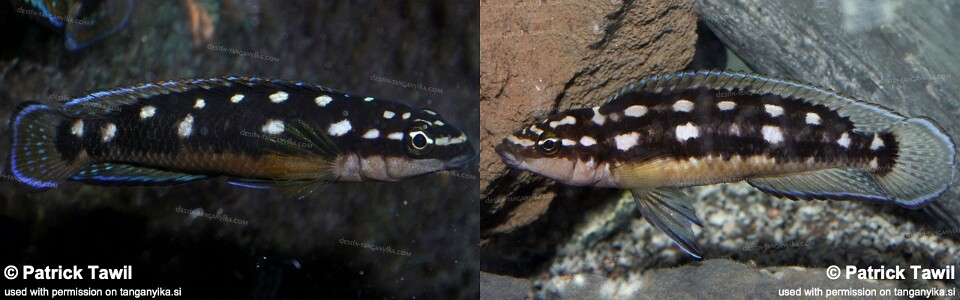



Two phenotypes are described: an “ornatoid” form with more irregular longitudinal stripes, and a “transcriptoid” form with a less checkered melanic pattern. Color pattern and the amount of yellow pigmentation are strongly influenced by environment and light conditions.
Many authors recognize numerous ornatus–transcriptus-like populations around the lake, but clear species boundaries remain unresolved. Pending further research, the Kapampa population — including nearby localities such as Nkorosha to the north and Kazia to the south — is treated here as a distinct, undescribed species.
Photo gallery