Julidochromis cf. regani 'Bulu Point' J. sp. 'Regani Karilani' Bulu Point
Tribe / Genus:
Lamprologini / Julidochromis
Type locality:
Nyanza, Lake Tanganyika, Burundi.
Biotope:
Intermediate habitat along sandy areas close to rocks.
Occurs mainly in shallow waters, usually around 10 meters depth.
Geographic distribution:
Endemic to Lake Tanganyika and historically reported throughout the lake,
making it the most widely distributed Julidochromis.
True Julidochromis regani is regarded as restricted to populations
around the type locality at Nyanza-Lac, in the area between Kaguna and Rumonge.
Populations north of Rumonge to Resha and around Bujumbura,
as well as south of Kaguna to Kaseke, are regarded as
Julidochromis cf. regani.
Further south, from Bulombora to the Kalambo River,
multiple regani-like populations are recognised by African Diving
and are here all treated as J. cf. regani.
Additional cf. regani populations are reported from Zambia
between Katete and at least Cape Chaitika,
and from parts of the Democratic Republic of the Congo,
although the southern extent of these populations remains debated.
Typical adult size:
Females up to 15 cm total length.
Males up to 10 cm total length.
Sexual dimorphism:
Sexes are difficult to distinguish by coloration.
Females are typically larger than males.
Recommended aquarium size:
150 L for a bonded pair
Aquarium setup:
Fine sand substrate with rockwork arranged to provide numerous hiding places.
Best to start with a group of 5–6 juveniles and remove excess individuals
once a pair forms after 14–18 months.
Regular water changes are required and strong aeration is recommended,
as the species prefers oxygen-rich water.
Can be kept with other similarly sized Tanganyikan cichlids.
Diet:
Omnivorous.
Feeds mainly on invertebrates searched for in aufwuchs,
while also ingesting a considerable amount of algae.
Breeding:
Cave spawner.
Breeds year-round, approximately every 4–6 weeks.
Males may spawn with more than one female,
but the female selects the spawning site.
Typical brood size ranges from 75 to 100 fry.
Fry from previous broods are tolerated up to about 3 cm in length,
after which they are driven away.
Aggression:
The least aggressive of all Julidochromis species,
though still quite aggressive toward conspecifics.
Special notes:
Julidochromis regani is characterized by horizontal stripes
running from the top to the bottom of the body, giving it an elongated appearance.
It is unique among Julidochromis in regularly venturing farther onto sandy
areas away from rocks.
Taxonomy within the J. regani complex is highly debated,
with many populations showing intermediate characteristics
between J. regani, J. marlieri, and J. marksmithi.


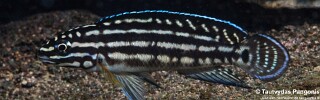
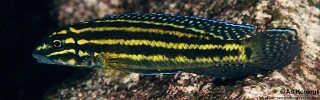



Photo gallery