Julidochromis cf. marlieri 'Katili' J. sp. 'Marlieri Nkonkonti' Katili
Tribe / Genus:
Lamprologini / Julidochromis
Type locality:
Makobola, Lake Tanganyika
Biotope:
Sediment-rich rocky habitat.
Occurs at depths of approximately 5–30 meters.
Geographic distribution:
Endemic to Lake Tanganyika.
Predominantly found in the northern and southern parts of the lake,
with scattered populations along the Tanzanian and DR Congo shorelines.
Typical adult size:
Females 10–13 cm total length.
Males 7–10 cm total length.
Sexual dimorphism:
Females are typically larger than males.
Recommended aquarium size:
120 L for a bonded pair
Aquarium setup:
Fine sand substrate with extensive rockwork arranged to create numerous caves and hiding places.
Only one pair should be kept per aquarium.
Best results are achieved by starting with a group of juveniles and removing excess individuals once a pair forms.
Can be kept with other Tanganyikan cichlids of similar size occupying different zones.
Diet:
Omnivorous.
Feeds mainly on invertebrates and small aquatic insects picked from algae and aufwuchs.
Sponges are also part of the natural diet.
Breeding:
Cave spawner.
Breeds year-round, approximately every 4–5 weeks.
Clutch size usually 50–75 eggs.
Both parents actively guard eggs and fry.
Aggression:
Moderate to high intraspecific aggression,
especially during territorial defense.
Aggression towards other species mainly occurs around the breeding territory.
Special notes:
Distinguished from other Julidochromis species by the characteristic stripe beneath the eye
and variable caudal fin patterns.
Vertical and horizontal stripes merge toward the abdomen, without a white belly.
Exhibits extensive geographical variation across the lake, including several dwarf and intermediate forms.
The taxonomic placement of many regional variants remains debated,
with some populations treated as Julidochromis cf. marlieri.

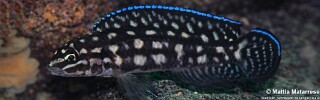

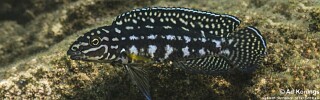



Photo gallery