South end of Lake Tanganyika, and Maswa, south of Ujiji.
Biotope:
Deep-water muddy habitats. Confined to deep water over soft substrates, especially extensive
shelf areas with little or no gradient and few or no rocks.
Geographic distribution:
Lake-wide distribution in Lake Tanganyika, restricted to deep muddy habitats. Particularly
abundant on southern mud-shelves, but also present off the Malagarazi River outlet, between
the Mahale Mountains and Cape Mpimbwe, around Kalemie, and north of the Ubwari Peninsula.
Typical adult size:
Up to 33 cm total length, though individuals above 22 cm are rare in the wild.
Sexual dimorphism:
Weakly developed. Males tend to grow larger than females and show distinct black blotches on
the anterior part of the flanks; females lack these markings.
Recommended aquarium size:
Very large aquaria required; minimum tank length approximately 160 cm.
Aquarium setup:
A large aquarium with a thick layer of fine sand and minimal decoration. If rocks are used,
they should be smooth and carefully placed to prevent fish from becoming trapped. Excellent
filtration and regular water changes are essential. Water should be hard and alkaline
(pH ≥ 7.5) with temperatures between 23–27 °C.
Diet:
Carnivorous. Feeds mainly on fish and shrimps. Recorded prey includes juvenile
Hemibates, as well as cichlids of the genera Trematocara and
Limnochromis. In the aquarium, suitable foods include chopped fish, shrimps,
mussels and high-quality prepared foods.
Breeding:
Maternal mouthbrooder. Females incubate few but very large eggs, approximately 7 mm in
diameter, among the largest eggs known in the family Cichlidae.
Special notes:
This species inhabits some of the deepest oxygenated zones of Lake Tanganyika, with most
individuals occurring between 160 and 215 m depth. It is one of very few cichlids capable of
tolerating extreme hypoxic conditions and can temporarily survive anoxic events during
upwelling. Together with Lates mariae and Chrysichthys stappersii, it is one
of the most abundant benthic predators on the southern mud-shelves of the lake.

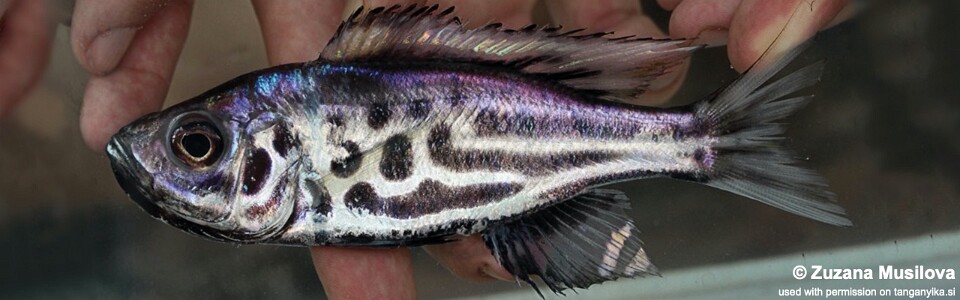



Photo gallery