Makombe, Burundi, approximately 37 km south of Bujumbura, Lake Tanganyika.
Biotope:
Upper part of the rocky shoreline in very shallow, wave-exposed water.
Highly adapted to turbulent conditions and therefore restricted to shallow
rocky habitats close to shore.
Geographic distribution:
Eretmodus marksmithi–like goby cichlids occur in the northern two thirds of Lake Tanganyika.
Unlike Eretmodus cyanostictus, which is often the only goby cichlid at a locality,
E. marksmithi almost always shares its habitat with two or more other goby cichlids,
most commonly species of the genera Spathodus and Tanganicodus, and often
also with E. cyanostictus.
Eretmodus marksmithi is found in Tanzania north of Korongwe Bay and in the Democratic
Republic of Congo north of Kalemie. Within this range, at least two populations are regarded
here as potentially distinct taxa.
The population occurring between the Ubwari Peninsula and the Rusizi River is recognized by
P. Tawil and cichlidae.com as a distinct species and referred to as
Eretmodus sp. 'Ubwari'. Ad Konings and Mark Smith, however, consider this population
a geographical variant of E. marksmithi.
Following African Diving, a second potentially distinct population is recognized between
Magambo and Sibwesa and is referred to
Eretmodus cf. marksmithi 'Magambo–Sibwesa'. This form differs from all other
E. marksmithi populations, including the original Burundi populations, by the
absence of blue dots on the head.
Specimens occasionally imported with the locality “Kalya” most likely do not originate
from that area, as Kalya represents suboptimal habitat for goby cichlids, especially
Eretmodus. Such fish are therefore presumed to originate from nearby, more suitable
localities.
Typical adult size:
Up to approximately 9 cm total length; females slightly smaller.
Recommended aquarium size:
Minimum 200 L for an established pair; considerably larger aquaria (>500 L)
required to keep more than one pair due to strong intraspecific aggression.
Aquarium setup:
Fine sand substrate combined with rocks forming crevices and shelters.
Strong water movement is recommended to simulate natural wave-exposed habitat.
Diet:
Primarily herbivorous. Feeds mainly on algae and aufwuchs scraped from rocks
(mostly filamentous algae), supplemented with small invertebrates.
Intestinal length is only 2–3 times body length, which is short for a
herbivorous cichlid.
Due to the shape of the mouth, Eretmodus marksmithi is able to graze
rocks in a more horizontal position compared to other eretmodines.
Breeding:
Biparental mouthbrooder. Both parents participate in brood care.
Eggs are laid on flat or slightly inclined rocks.
The female incubates eggs and larvae for about 10–14 days, then transfers the
brood to the male, who carries them for an additional 7–8 days.
Brood size usually up to about 35 fry. After release, fry receive no parental care.
Aggression:
Extremely aggressive towards conspecifics. Relatively tolerant toward other
species. Keeping more than one pair requires very large aquaria.
Special notes:
Formerly known in the hobby as Eretmodus sp. 'cyanostictus north' or
simply Eretmodus sp. 'north'.
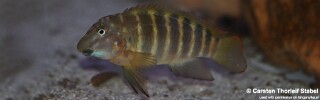
Distinguished from E. cyanostictus by its very wide, squarish mouth
(widest among eretmodines) and by vertical bars extending across the full height
of the flank (“full bar” pattern). In E. cyanostictus, bars are restricted
to the lower half of the body and the upper flanks are covered with bright blue spots.
Some geographical variation is present within E. marksmithi, though much
less pronounced than in many other Tanganyikan cichlids. Misidentification in the
aquarium trade is common, with northern populations often sold incorrectly as
E. cyanostictus.




Eretmodus marksmithi is found in Tanzania north of Korongwe Bay and in the Democratic Republic of Congo north of Kalemie. Within this range, at least two populations are regarded here as potentially distinct taxa.
The population occurring between the Ubwari Peninsula and the Rusizi River is recognized by P. Tawil and cichlidae.com as a distinct species and referred to as Eretmodus sp. 'Ubwari'. Ad Konings and Mark Smith, however, consider this population a geographical variant of E. marksmithi.
Following African Diving, a second potentially distinct population is recognized between Magambo and Sibwesa and is referred to Eretmodus cf. marksmithi 'Magambo–Sibwesa'. This form differs from all other E. marksmithi populations, including the original Burundi populations, by the absence of blue dots on the head.
Specimens occasionally imported with the locality “Kalya” most likely do not originate from that area, as Kalya represents suboptimal habitat for goby cichlids, especially Eretmodus. Such fish are therefore presumed to originate from nearby, more suitable localities.
Due to the shape of the mouth, Eretmodus marksmithi is able to graze rocks in a more horizontal position compared to other eretmodines.
The female incubates eggs and larvae for about 10–14 days, then transfers the brood to the male, who carries them for an additional 7–8 days. Brood size usually up to about 35 fry. After release, fry receive no parental care.
Distinguished from E. cyanostictus by its very wide, squarish mouth (widest among eretmodines) and by vertical bars extending across the full height of the flank (“full bar” pattern). In E. cyanostictus, bars are restricted to the lower half of the body and the upper flanks are covered with bright blue spots.
Some geographical variation is present within E. marksmithi, though much less pronounced than in many other Tanganyikan cichlids. Misidentification in the aquarium trade is common, with northern populations often sold incorrectly as E. cyanostictus.
Photo gallery