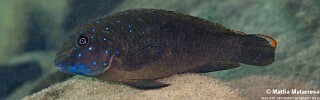
Mbity Rocks and Kinyamkolo, Lake Tanganyika (Zambia).
Biotope:
Upper zone of the rocky shoreline in very shallow, wave-swept water.
Highly adapted to turbulent surf conditions and therefore not found away from this habitat.
Poorer swimmer than most cichlids; relies on camouflage and high-set eyes to detect danger (often from birds).
Geographic distribution:
Endemic to Lake Tanganyika. Eretmodus cyanostictus is the only goby cichlid occurring in the southern part
of the lake. In Tanzania it is found south of Kampemba Point (just south of Korongwe Bay), where it comes into
contact and hybridises with Eretmodus marksmithi.
The species occurs along the entire Zambian shoreline and in the Democratic Republic of Congo probably northwards
at least to Kalemie. It is also present around the Kavala Islands, where it shares habitat with
E. marksmithi (hybridisation at this locality is currently undocumented).
Populations resembling E. cyanostictus are also found between Kigoma and Halembe. These are regarded by
African Diving as potentially distinct and are referred to as
Eretmodus cf. cyanostictus 'Kigoma–Halembe'.
Notably, between Kigoma and Halembe four goby cichlid species occur sympatrically:
E. cf. cyanostictus 'Kigoma–Halembe', E. marksmithi,
Spathodus sp. 'erythrodon north' and Tanganicodus irsacae.
Typical adult size:
Up to about 9 cm. Females are typically 1–2 cm smaller than males.
Sexual dimorphism:
Minimal externally; females are usually smaller. Pair members are otherwise very similar in appearance.
Recommended aquarium size:
About 200 L for a well-established pair. For keeping more than one pair/group, over 500 L is recommended due to
severe intraspecific aggression.
Aquarium setup:
Fine sand combined with rocks. Use rocks to create multiple shelters and visual breaks.
Strong filtration and high water movement are recommended to mimic surf-zone conditions.
Suitable tank mates (where appropriate) include algae-grazing, rock-associated cichlids such as
Tropheus and Petrochromis, provided the aquarium is large and stable.
Diet:
Primarily herbivorous aufwuchs grazer (especially filamentous algae) scraped from rocks; also ingests small
invertebrates incidentally. Notably, intestine length is only about 2–3× body length, which is short for an
herbivorous Tanganyikan cichlid (e.g., much shorter than in many Petrochromis).
Breeding:
Biparental mouthbrooder. A pair typically bonds for life and both partners defend the territory.
Spawning occurs on a flat or slightly sloped rock. The female lays eggs and immediately picks them up; the male
releases milt which the female also collects, so fertilization occurs inside the female’s mouth.
Female incubates for about 10–14 days (until fry are ~8–10 mm), then transfers the brood to the male who carries
them for another ~7–8 days. The incubating parent does not feed; the other feeds normally. Brood size is usually
up to ~35 fry. After release, parents do not guard the fry and largely ignore them.
Aggression:
Extremely aggressive toward conspecifics; much less territorial toward other species.
In small aquaria typically only one pair can be kept safely.
Special notes:
Often called “Tanganyikan clowns” due to their unusual movement and behaviour.
Within Eretmodus, two accepted species are commonly recognized:
E. cyanostictus and E. marksmithi (formerly traded as E. sp. 'north' / E. sp. 'cyanostictus north').
Some authors mention E. sp. 'ubwari', but Ad Konings considers it a geographical variant of
E. marksmithi.
Key differences vs. E. marksmithi: E. cyanostictus has moderately wide, more rounded mouth;
vertical bars usually extend only from the lower flank to about mid-body, while the upper flank commonly shows
brilliant blue spots. In E. marksmithi, vertical bars are typically complete from belly to back (“full bar”),
and the mouth is broader and more squarish.





The species occurs along the entire Zambian shoreline and in the Democratic Republic of Congo probably northwards at least to Kalemie. It is also present around the Kavala Islands, where it shares habitat with E. marksmithi (hybridisation at this locality is currently undocumented).
Populations resembling E. cyanostictus are also found between Kigoma and Halembe. These are regarded by African Diving as potentially distinct and are referred to as Eretmodus cf. cyanostictus 'Kigoma–Halembe'.
Notably, between Kigoma and Halembe four goby cichlid species occur sympatrically: E. cf. cyanostictus 'Kigoma–Halembe', E. marksmithi, Spathodus sp. 'erythrodon north' and Tanganicodus irsacae.
Female incubates for about 10–14 days (until fry are ~8–10 mm), then transfers the brood to the male who carries them for another ~7–8 days. The incubating parent does not feed; the other feeds normally. Brood size is usually up to ~35 fry. After release, parents do not guard the fry and largely ignore them.
Key differences vs. E. marksmithi: E. cyanostictus has moderately wide, more rounded mouth; vertical bars usually extend only from the lower flank to about mid-body, while the upper flank commonly shows brilliant blue spots. In E. marksmithi, vertical bars are typically complete from belly to back (“full bar”), and the mouth is broader and more squarish.
Photo gallery