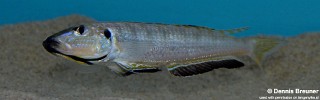
Moliro, Lake Tanganyika, Democratic Republic of Congo (Zaire)
Biotope:
Open sandy substrate. Lives over sand but breeds near rocky areas.
Found at depths down to about 40 m; during the breeding season occurs
in much shallower water.
Geographic distribution:
Lake-wide distribution throughout Lake Tanganyika.
Typical adult size:
Males up to about 15 cm; females usually slightly smaller.
Sexual maturity is reached at approximately one year of age.
Sexual dimorphism:
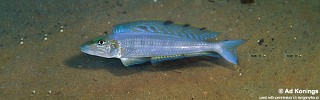
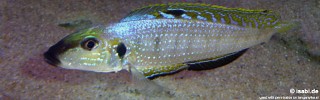
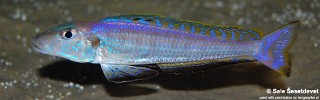
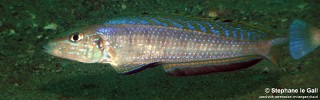
Females and non-breeding males are sandy-silvery and blend well with the
substrate. Territorial breeding males develop a spectacular coloration.
Recommended aquarium size:
Minimum 300 L; aquaria of at least 120 cm length and 50 cm depth are recommended.
Aquarium setup:
Large open sandy areas with fine sand are essential. Only a few rocks should
be provided. This species lives naturally in large, stable social groups and
should be kept in groups of at least 5–7 individuals.
Best kept in a species-only aquarium. If tank mates are desired, choose calm
mid- or upper-water species such as Paracyprichromis.
Mouthbrooding females should be removed carefully after about two weeks of
incubation, preferably at night, to avoid stress and premature release of fry.
Diet:
Carnivorous. Feeds mainly on small crustaceans collected from the upper layer
of the sand. In the aquarium accepts frozen foods and high-quality dry foods.
Breeding:
Maternal mouthbrooder. Only the female incubates eggs and larvae.
Breeding occurs throughout the year, with peak activity during the rainy season
(December–May).
Males construct flat, saucer-shaped spawning sites in the sand near rocky areas.
Spawning follows a typical mouthbrooder courtship ritual. A clutch usually
contains 30–80 eggs. Females incubate for about three weeks before releasing fry.
No parental care is provided after release.
Aggression:
Peaceful both towards conspecifics and other species. Multiple males can be
kept together without serious aggression.
Special notes:
Enantiopus melanogenys was historically placed in the genus
Xenotilapia, but DNA analysis (Kidd, 2012) confirmed that it belongs
to Enantiopus.
It differs from Xenotilapia by its very elongated snout, depressed head,
more developed vertical fins (especially the anal fin), and a different
pharyngeal apophysis type.
The closely related Enantiopus sp. 'kilesa' differs by a shorter lower
jaw, shorter snout and yellow coloration on the chin, and is best regarded as
a separate species pending further study.



Best kept in a species-only aquarium. If tank mates are desired, choose calm mid- or upper-water species such as Paracyprichromis.
Mouthbrooding females should be removed carefully after about two weeks of incubation, preferably at night, to avoid stress and premature release of fry.
Males construct flat, saucer-shaped spawning sites in the sand near rocky areas. Spawning follows a typical mouthbrooder courtship ritual. A clutch usually contains 30–80 eggs. Females incubate for about three weeks before releasing fry. No parental care is provided after release.
It differs from Xenotilapia by its very elongated snout, depressed head, more developed vertical fins (especially the anal fin), and a different pharyngeal apophysis type.
The closely related Enantiopus sp. 'kilesa' differs by a shorter lower jaw, shorter snout and yellow coloration on the chin, and is best regarded as a separate species pending further study.
Photo gallery