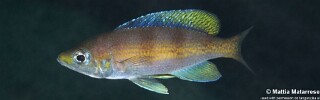
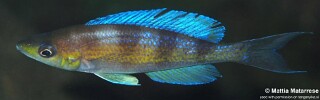
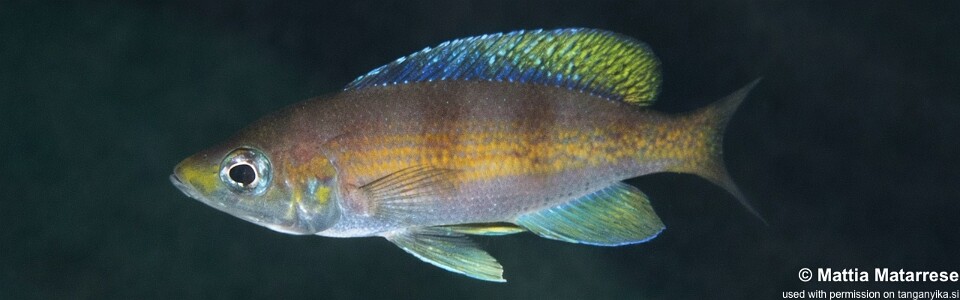
Kasenga, Zambia, at a depth of 11 meters, Lake Tanganyika.
Biotope:
Open water of deep rocky shores. Typically inhabits depths below 20 m.
Occurs in large schools together with Cyprichromis leptosoma,
C. pavo and C. coloratus.
Geographic distribution:
Endemic to Lake Tanganyika. Restricted to the southern part of the lake,
primarily along the western shore of Chituta Bay and Cape Kaku in Zambia.
Typical adult size:
Males up to about 10 cm; females slightly smaller.
Recommended aquarium size:
Minimum 300 L.
Aquarium setup:
Provide a relatively dark aquarium, reflecting its deep-water habitat.
Include a few rocks for orientation and shelter, but ensure plenty of
open swimming space. Substrate choice is not critical, as this species
does not feed or spawn on the bottom. Best kept in groups of at least
10 individuals.
Diet:
Carnivorous. Feeds mainly on zooplankton and small invertebrates in the
water column.
Breeding:
Maternal mouthbrooder. Unlike most Cyprichromis species, males do not
defend three-dimensional territories in open water. Instead, a male
maintains a territory facing a vertical rock surface, where spawning
occurs. Females lay 6–15 eggs, but usually release fewer than 8 fry after
an incubation period of about four weeks.
Aggression:
Relatively peaceful and suitable for community aquaria with other
Tanganyikan sand- and open-water dwellers.
Special notes:
Previously known as 'Zebra Leptosoma' or 'Wimple Leptosoma'.
Males are characterized by broad vertical bars on the body, which are not
always visible. Unlike most Cyprichromis species, males are not polymorphic;
all males within a population show similar coloration.
Until recently, Cyprichromis zonatus was believed to occur only
along a limited stretch of the southern shoreline, from western Chituta Bay
to Cape Kaku. African Diving later discovered two very similar populations,
named C. sp. 'Mpimbwe Zebra' and C. sp. 'Kipili Zebra'.
Ad Konings considers these to be geographical variants of
C. zonatus, while African Diving treats them as potentially distinct
species pending detailed taxonomic study.





Until recently, Cyprichromis zonatus was believed to occur only along a limited stretch of the southern shoreline, from western Chituta Bay to Cape Kaku. African Diving later discovered two very similar populations, named C. sp. 'Mpimbwe Zebra' and C. sp. 'Kipili Zebra'. Ad Konings considers these to be geographical variants of C. zonatus, while African Diving treats them as potentially distinct species pending detailed taxonomic study.
Photo gallery