Open water of deep rocky shores. Occurs at depths of approximately
5–30 m, where it lives in relatively large schools.
Geographic distribution:
Northern part of the eastern shore of Lake Tanganyika, mainly around
Kigoma and southwards to Halembe. It may also occur further north,
possibly reaching the Burundi–Tanzania border, and potentially along
the northern Congolese coast.
Typical adult size:
A small Cyprichromis species, reaching a maximum size of about 10 cm
total length.
Sexual dimorphism:
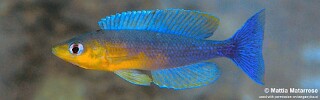
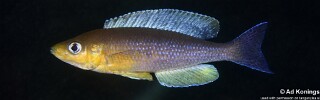
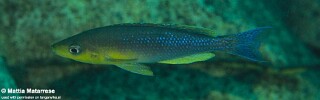
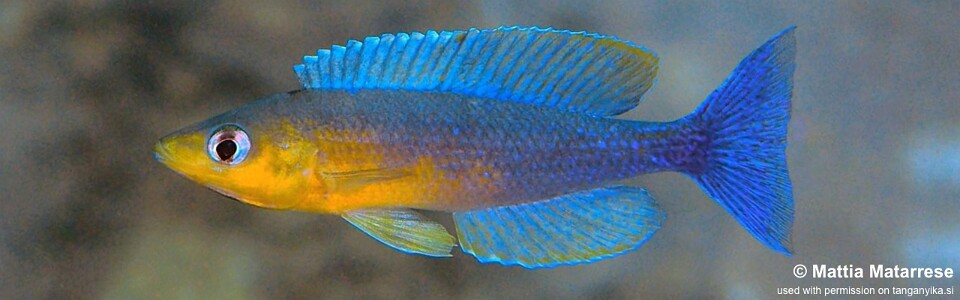
Males are more colourful and slightly larger than females. Males are
polymorphic, exhibiting either blue or yellow caudal fins. Females are
beige to light brown, with a yellowish anal fin.
Recommended aquarium size:
Minimum 300 L
Aquarium setup:
A minimum aquarium size of 300 L is recommended. The species should be
kept in groups of at least 3–4 males and at least an equal number of
females. Keeping only a single male prevents observation of natural
three-dimensional territorial behaviour, while keeping only two males
often results in excessive aggression between them.
With several males, aggression is distributed and social interactions
are more balanced. Compared to Cyprichromis leptosoma, this
species is slightly less aggressive and can be kept with most
sand-dwelling Tanganyikan cichlids.
Provide some rocks for shelter, but ensure plenty of open swimming
space. Substrate choice is not important, as the species does not feed
or spawn on the bottom.
Diet:
Carnivorous planktivore. In the wild feeds mainly on zooplankton, but
also consumes small invertebrates when plankton availability is low.
Prey is captured using a highly protrusible mouth adapted for feeding
in open water.
Breeding:
Maternal mouthbrooder. Males maintain three-dimensional territories in
open water and attempt to attract passing females. During spawning,
females are drawn to the yellow-tipped ventral fins and rapidly collect
fertilised eggs in their mouth. Incubation lasts approximately three
weeks. Typical clutch size is 8–15 eggs.
Aggression:
Slightly less aggressive than Cyprichromis leptosoma. Males may
occasionally chase bottom-dwelling tank mates but usually do not cause
physical harm. Suitable for community Tanganyika aquaria, except with
predatory species.
Special notes:
This species was long regarded as a geographical variant of
Cyprichromis leptosoma. In size and body proportions it is close
to C. leptosoma, but its matte coloration—especially the
yellow-brown head lacking the bright blue sheen typical of
C. leptosoma—and its slightly calmer temperament make it more
similar to Cyprichromis sp. 'leptosoma jumbo'. This combination
of characters gave rise to the name “dwarf jumbo”.
Males are polymorphic, with either blue or yellow caudal fins. Females
are uniformly coloured. Compared to the true jumbo forms, this species
remains smaller and more slender.
Known under several trade or provisional names, including
C. sp. 'leptosoma kigoma' (Ad Konings) and
C. sp. 'Jumbo Yellow Breast' (African Diving Ltd.). It replaces
C. leptosoma along the northernmost part of the eastern shore of
the lake.



With several males, aggression is distributed and social interactions are more balanced. Compared to Cyprichromis leptosoma, this species is slightly less aggressive and can be kept with most sand-dwelling Tanganyikan cichlids.
Provide some rocks for shelter, but ensure plenty of open swimming space. Substrate choice is not important, as the species does not feed or spawn on the bottom.
Males are polymorphic, with either blue or yellow caudal fins. Females are uniformly coloured. Compared to the true jumbo forms, this species remains smaller and more slender.
Known under several trade or provisional names, including C. sp. 'leptosoma kigoma' (Ad Konings) and C. sp. 'Jumbo Yellow Breast' (African Diving Ltd.). It replaces C. leptosoma along the northernmost part of the eastern shore of the lake.
Photo gallery