Wonzye Point, Lake Tanganyika, Zambia (approx. 12 m depth)
Biotope:
Open water along deep rocky shores. Occurs in large schools together with
Cyprichromis leptosoma, C. pavo and
C. sp. 'leptosoma jumbo'. Found at depths of approximately
7–30 m.
Geographic distribution:
Southern part of Lake Tanganyika, from the Kalambo River area (border between
Tanzania and Zambia) to Mbete Bay. Possibly also present along the southern
part of the Ulungu Escarpment.
Typical adult size:
A relatively large species of Cyprichromis, reaching up to
approximately 14 cm total length.
Sexual dimorphism:
Males are more intensely coloured and slightly larger than females.
Males are polymorphic, showing different colour combinations within
the same population.
Recommended aquarium size:
Minimum 400 L
Aquarium setup:
A schooling species that should be kept in groups of at least 10 individuals.
A sex ratio of 1:1 is acceptable, though 1 male to 2 females is preferable.
Provide open swimming space with a few larger rocks to offer refuge for
subordinate individuals. Substrate choice is not critical, as this species
feeds in the water column and does not use the substrate for breeding.
Due to its relatively aggressive nature, it should not be kept with very
delicate Tanganyikan species.
Diet:
Carnivorous planktivore. Feeds mainly on plankton and small crustaceans
captured in the open water using its highly protrusible mouth.
Breeding:
Maternal mouthbrooder. Males maintain a three-dimensional territory in
open water and attempt to attract passing females. During spawning,
the male bends his body and vibrates the ventral fins. The female releases
eggs, which are immediately taken into the mouth. Incubation lasts
approximately three weeks.
Aggression:
Can be relatively aggressive and territorial. Not recommended to keep with
sensitive sand-dwelling species such as Xenotilapia, but compatible
with more robust species like Callochromis.
Special notes:
Previously known in the hobby as Cyprichromis sp. 'Leptosoma Goldfin'
or 'Grandiosus', and once thought to be identical to
C. sp. 'leptosoma jumbo'. The two species are now known to occur
sympatrically, for example at Isanga.
Males are distinctly polymorphic: some have blue caudal fins with yellow
dorsal fins, while others show yellow caudal fins with light blue dorsal fins.
This dichromatism within a single population is a characteristic feature of
the species.

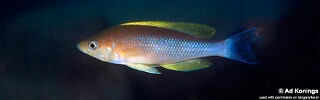
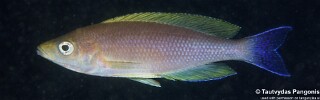

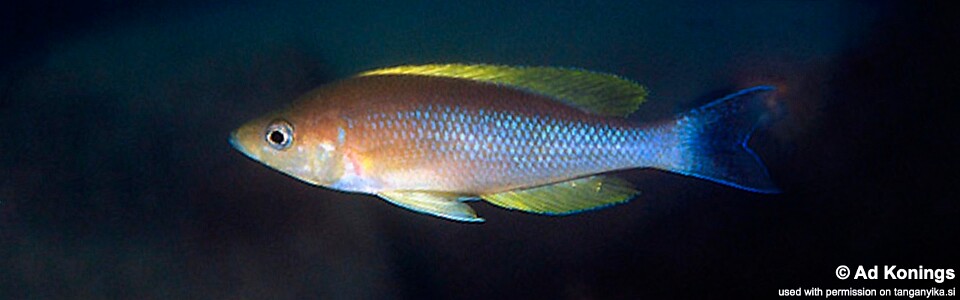



Males are distinctly polymorphic: some have blue caudal fins with yellow dorsal fins, while others show yellow caudal fins with light blue dorsal fins. This dichromatism within a single population is a characteristic feature of the species.
Photo gallery