Intermediate habitat, usually between rocky and sandy areas, typically at depths of
about 5–20 m.
Geographic distribution:
Southern half of Lake Tanganyika, extending northward along the Congolese coast to the
Kabimba area; northernmost records on the eastern shore reach the Sibwesa region.
Typical adult size:
Males up to about 14–16 cm total length; females usually up to about 11–12 cm.
Sexual dimorphism:
Males are larger and develop stronger breeding coloration (blue to brown depending on
locality). Females are smaller, silvery to light grey, often with a dark spot in the dorsal fin.
Recommended aquarium size:
At least 400 L (minimum length about 150 cm).
Aquarium setup:
Fine sand substrate is essential. Sandy areas should be broken up with several larger
rocks or stones, which males use as reference points for building bowers.
Best kept with a single adult male and several females, together with other peaceful
Tanganyikan cichlids.
Diet:
Primarily herbivorous, feeding on diatoms and fine algae scraped from aufwuchs.
In the aquarium it requires a strict vegetable-based diet (high-quality green flakes);
animal foods should be avoided or offered only very sparingly.
Breeding:
Maternal mouthbrooder. Males construct crescent-shaped sand-scrape bowers close to rocks.
Spawning takes place in the bower; the female collects the eggs and incubates them in her mouth
for roughly three weeks. No post-release parental care has been observed.
Aggression:
Moderately aggressive. Territorial males defend their bower but are generally compatible
with other non-aggressive Tanganyikan cichlids.
Special notes:
A specialized algivore with an exceptionally long intestine, similar in feeding strategy
to Petrochromis. Sometimes confused in the past with small
Cyathopharynx species. Several geographical variants are known, mainly differing
in male breeding coloration.


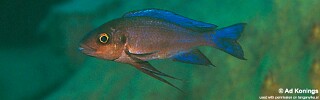



Photo gallery