Shallow, sediment-rich habitats, often in sheltered bays and near river mouths.
Occurs at depths of approximately 1–6 m.
Water clarity is usually reduced due to suspended sediment.
Aquatic plants such as Vallisneria spiralis, Ceratophyllum demersum and
Hydrilla verticillata are often present.
Geographic distribution:
Endemic to Lake Tanganyika.
Restricted to the northern part of the lake, from Cape Caramba (Ubwari Peninsula, DR Congo)
to Nyanza-Lac in Burundi.
Typical adult size:
Up to approximately 15 cm total length.
Females remain several centimeters smaller than males.
Sexual dimorphism:
Pronounced sexual dimorphism.
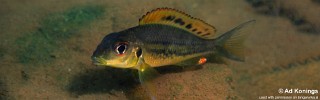
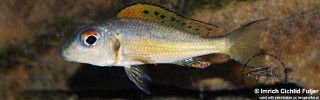
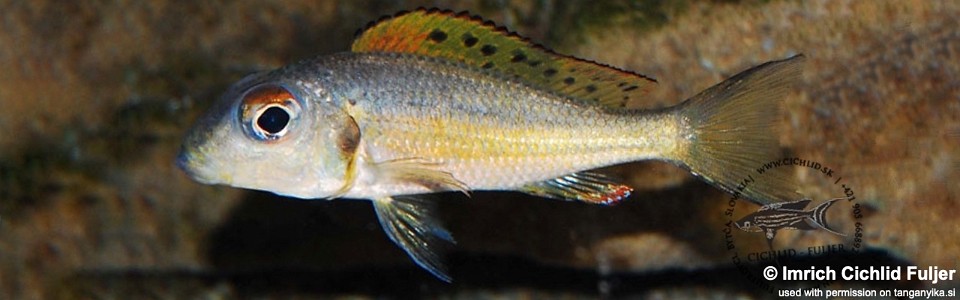
Males are larger and more intensely colored.
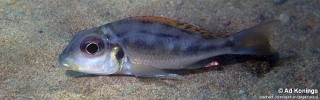
Females remain silvery-grey throughout their lives.
Recommended aquarium size:
At least 300 L.
Aquarium setup:
Fine sand substrate is essential.
Use rocks to create caves and visual barriers.
Aquatic plants are recommended to provide refuge for females.
Best kept in a harem structure of one male with at least three females.
Two males should only be kept together in very large aquaria.
Diet:
Carnivorous.
Feeds mainly on insect larvae and micro-organisms sifted from the sand.
In aquaria, accepts frozen foods such as mysis, daphnia and cyclops,
as well as high-quality prepared foods.
Breeding:
Maternal mouthbrooder.
The male builds a volcano-shaped sand mound, about 20–30 cm high
and roughly 35 cm in diameter, with a spawning platform on top.
Nests are spaced about 2–3 meters apart in nature.
Eggs are collected immediately by the female and fertilized using anal-fin egg dummies.
Typical brood size ranges from approximately 25 to 60 fry.
Aggression:
Males are strongly aggressive toward each other.
Toward other species, aggression is generally moderate.
Special notes:
Long considered a subspecies of Callochromis macrops and likely evolved from it.
Closely related to C. macrops, differing mainly in male coloration.
Although geographic variation exists, differences are less pronounced than in C. macrops.
The taxonomic separation between these species is still debated, and they may represent
closely related geographic forms rather than fully distinct species.



Occurs at depths of approximately 1–6 m.
Water clarity is usually reduced due to suspended sediment.
Aquatic plants such as Vallisneria spiralis, Ceratophyllum demersum and Hydrilla verticillata are often present.
Restricted to the northern part of the lake, from Cape Caramba (Ubwari Peninsula, DR Congo) to Nyanza-Lac in Burundi.
Females remain several centimeters smaller than males.
Males are larger and more intensely colored.
Females remain silvery-grey throughout their lives.
Use rocks to create caves and visual barriers.
Aquatic plants are recommended to provide refuge for females.
Best kept in a harem structure of one male with at least three females.
Two males should only be kept together in very large aquaria.
Feeds mainly on insect larvae and micro-organisms sifted from the sand.
In aquaria, accepts frozen foods such as mysis, daphnia and cyclops, as well as high-quality prepared foods.
The male builds a volcano-shaped sand mound, about 20–30 cm high and roughly 35 cm in diameter, with a spawning platform on top.
Nests are spaced about 2–3 meters apart in nature.
Eggs are collected immediately by the female and fertilized using anal-fin egg dummies.
Typical brood size ranges from approximately 25 to 60 fry.
Toward other species, aggression is generally moderate.
Closely related to C. macrops, differing mainly in male coloration.
Although geographic variation exists, differences are less pronounced than in C. macrops.
The taxonomic separation between these species is still debated, and they may represent closely related geographic forms rather than fully distinct species.
Photo gallery