Deep rocky and intermediate habitats, mostly between 50 and 200 m depth.
The majority of the population inhabits very deep, dimly lit zones over muddy bottoms.
A smaller fraction of individuals ascends to shallower water (approximately 20–50 m)
for breeding, typically at the edge of rocky habitats where sand-covered rocks occur.
Geographic distribution:
Lake Tanganyika. Probably lake-wide, with known populations from multiple regions
including Zambia, Tanzania, the Democratic Republic of Congo, and Burundi.
Several geographic variants are known.
Typical adult size:
Males commonly up to about 25 cm total length; females remain slightly smaller.
Maximum size varies somewhat between geographic populations.
Sexual dimorphism:
Strong sexual dichromatism. Females are silvery to grey and lack horizontal stripes.
Males are bluish to violet with three prominent horizontal light-blue stripes
(sometimes a faint fourth stripe is present).
Males also have markedly elongated pelvic and caudal fins compared to females.
Recommended aquarium size:
Minimum 500 L; aquarium length at least 150 cm and height at least 60 cm
for a pair or one male with several females.
Aquarium setup:
A spacious, dimly lit aquarium with a fine sand substrate.
Provide at least one large, flat-topped stone or suitable elevated surface
that can serve as a spawning site for the male.
Best kept as one male with several females; never keep more than one male per aquarium,
as male–male aggression is severe even in very large tanks.
Tankmates should be peaceful sand-dwelling species such as
Xenotilapia, Ectodus, or Enantiopus;
aggressive or fin-nipping species are unsuitable.
Diet:
Carnivorous planktivore. In nature feeds mainly on zooplankton, especially copepods.
In aquaria, best fed with Cyclops, Daphnia, Artemia, and other suitable frozen or live foods.
Breeding:
Maternal mouthbrooder with a highly specialized reproductive strategy.
Breeding males defend large territories (5–10 m apart in nature) and construct
a spawning site either on top of a large rock or, in some populations,
a sand mound resembling a small volcano (30–50 cm diameter).
Spawning does not involve the typical circular movement of mouthbrooders;
the female lays single eggs and immediately picks them up by swimming backwards.
Clutch size is extremely small, usually 3–5 eggs and rarely more than a dozen.
Females incubate the brood for an exceptionally long time—often around two months
and in some cases over 100 days—while continuing to feed during incubation.
Fry are released at a relatively large size (around 30–35 mm).
Aggression:
Generally peaceful toward other species.
Extremely aggressive between males of the same species; only one male should be kept.
Special notes:
Often known as the “Princess of the Deep”. For many years misidentified in the aquarium hobby
as Benthochromis tricoti; all aquarium specimens previously labelled as
B. tricoti are in fact B. horii.
The only species of the genus regularly observed in relatively shallow water during breeding.
The prolonged mouthbrooding period and extremely small clutch size are thought to be adaptations
to intense predation pressure from deep-water predators such as species of Bathybates.
Distinguished from other Benthochromis species by mouth angle, head proportions,
fin morphology, and—most clearly in males—by the presence of three horizontal stripes
(two in B. tricoti, none in B. melanoides).




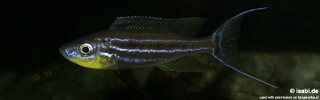



Males also have markedly elongated pelvic and caudal fins compared to females.
Provide at least one large, flat-topped stone or suitable elevated surface that can serve as a spawning site for the male.
Best kept as one male with several females; never keep more than one male per aquarium, as male–male aggression is severe even in very large tanks.
Tankmates should be peaceful sand-dwelling species such as Xenotilapia, Ectodus, or Enantiopus; aggressive or fin-nipping species are unsuitable.
In aquaria, best fed with Cyclops, Daphnia, Artemia, and other suitable frozen or live foods.
Breeding males defend large territories (5–10 m apart in nature) and construct a spawning site either on top of a large rock or, in some populations, a sand mound resembling a small volcano (30–50 cm diameter).
Spawning does not involve the typical circular movement of mouthbrooders; the female lays single eggs and immediately picks them up by swimming backwards. Clutch size is extremely small, usually 3–5 eggs and rarely more than a dozen.
Females incubate the brood for an exceptionally long time—often around two months and in some cases over 100 days—while continuing to feed during incubation. Fry are released at a relatively large size (around 30–35 mm).
The only species of the genus regularly observed in relatively shallow water during breeding. The prolonged mouthbrooding period and extremely small clutch size are thought to be adaptations to intense predation pressure from deep-water predators such as species of Bathybates.
Distinguished from other Benthochromis species by mouth angle, head proportions, fin morphology, and—most clearly in males—by the presence of three horizontal stripes (two in B. tricoti, none in B. melanoides).
Photo gallery