Open water over sandy areas near shore, from very shallow water down to about 70 m.
Juveniles (roughly 3–10 cm) are most often found in extremely shallow water, frequently below 5 m.
Geographic distribution:
Lake Tanganyika. Widespread throughout the lake.
Typical adult size:
Up to about 36–38 cm total length.
Sexual dimorphism:
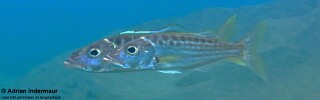
Females are generally less colourful than males and may lack the blue highlights seen in males.
Females often show two horizontal rows of light brownish spots on the upper half of the body, and the unpaired fins are usually unpatterned.
Recommended aquarium size:
1000 L (minimum)
Aquarium setup:
A large, dimly lit aquarium with extensive open swimming space is essential.
Use a fine sand substrate; stones should be minimal or absent, and if used they should be smooth with no sharp edges.
Do not keep with aggressive tankmates.
Diet:
Carnivorous predator. Feeds mainly on sand-dwelling cichlids (especially Ectodini, such as Xenotilapia)
and, to a lesser extent, on Lake Tanganyika sardines.
In aquaria, it accepts a variety of suitable live and frozen foods.
Breeding:
Maternal mouthbrooder. Adults likely move into shallower sandy zones to spawn.
Broods may be large (up to around 80), with juveniles released at roughly 17 mm total length.
Brood time can be around five weeks under warm conditions.
Juveniles remain in shallow water and join schools of other silvery young fishes.
Aggression:
Generally peaceful toward similarly sized fishes, but smaller species must not be kept with it, as they will be preyed upon.
Special notes:
Closely related to Bathybates graueri, but differs by its larger maximum size and a different body pattern:
B. ferox typically shows horizontal rows of spots that may merge into short bars, whereas B. graueri shows
distinct vertical bars and horizontal stripes toward the caudal fin.
Notably, it often attacks only live, moving fish—likely reflecting adaptation to deeper-water hunting where detecting movement is critical.




Use a fine sand substrate; stones should be minimal or absent, and if used they should be smooth with no sharp edges.
Do not keep with aggressive tankmates.
In aquaria, it accepts a variety of suitable live and frozen foods.
Broods may be large (up to around 80), with juveniles released at roughly 17 mm total length. Brood time can be around five weeks under warm conditions. Juveniles remain in shallow water and join schools of other silvery young fishes.
Notably, it often attacks only live, moving fish—likely reflecting adaptation to deeper-water hunting where detecting movement is critical.
Photo gallery