Primarily deep open-water habitats over sandy substrate.
Adults inhabit deep waters, commonly down to 160–200 m, while juveniles are frequently found in very shallow sandy areas,
often less than 5 m deep.
Geographic distribution:
Lake Tanganyika. Widespread throughout the lake.
Typical adult size:
Up to about 41 cm total length.
Sexual dimorphism:
No pronounced external sexual dimorphism has been documented.
Brooding females may show duller coloration compared to males.
Recommended aquarium size:
800 L
Aquarium setup:
A large, dimly lit aquarium with extensive open swimming space is essential.
Use a fine sand substrate; rocks should be minimal or absent.
Best kept alone or together with other large open-water predators such as
Bathybates or Haplotaxodon.
Diet:
Carnivorous predator. Feeds predominantly on Lake Tanganyika sardines
(Stolothrissa and Limnothrissa), occasionally also on small cichlids and shrimps.
In aquaria, accepts a variety of live and frozen foods.
Breeding:
Maternal mouthbrooder. Adults migrate from deep water to shallow sandy areas for spawning.
Females brood approximately 30 eggs for about 38 days.
Fry are released at around 17 mm total length and remain in shallow habitats,
often schooling with juvenile sardines and other silvery fishes.
Aggression:
Generally peaceful toward similarly sized fishes.
Smaller species should not be kept with it, as they will be preyed upon.
Special notes:
Closely related to Bathybates horni and Bathybates leo.
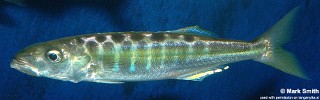
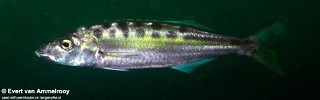
Differs from B. horni by having fewer vertical bars (6–7 vs. 12–14),
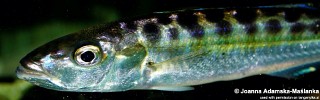
a more slender body, a smaller mouth, and a much larger maximum size.
Differs from B. leo by lacking the characteristic horizontal striping pattern
and by its larger adult size.
An open-water predator that relies on its resemblance to sardines to approach prey unnoticed.
Rarely collected for aquaria and more commonly encountered as bycatch in sardine fisheries.



Use a fine sand substrate; rocks should be minimal or absent. Best kept alone or together with other large open-water predators such as Bathybates or Haplotaxodon.
In aquaria, accepts a variety of live and frozen foods.
Females brood approximately 30 eggs for about 38 days. Fry are released at around 17 mm total length and remain in shallow habitats, often schooling with juvenile sardines and other silvery fishes.
Differs from B. horni by having fewer vertical bars (6–7 vs. 12–14), a more slender body, a smaller mouth, and a much larger maximum size. Differs from B. leo by lacking the characteristic horizontal striping pattern and by its larger adult size.
An open-water predator that relies on its resemblance to sardines to approach prey unnoticed. Rarely collected for aquaria and more commonly encountered as bycatch in sardine fisheries.
Photo gallery