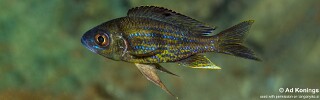
Moliro, Lake Tanganyika (Democratic Republic of Congo).
Biotope:
Intermediate habitats with sandy substrate mixed with pebbles and scattered rocks.
Typically found at shallow depths, generally from about 1–10 m, often less than 5 m.
Geographic distribution:
Lake Tanganyika. Widespread around the lake, with some regional colour variation;
northern populations appear less yellow than southern ones.
Typical adult size:
Males usually reach about 13–15 cm total length; females remain smaller, around 10 cm.
Sexual dimorphism:
Females are smaller and less colourful than males, with noticeably shorter fins,
especially the pelvic fins.
Recommended aquarium size:
300 L
Aquarium setup:
Use a fine sand substrate, broken up by scattered groups of rocks.
Open sandy areas are important for nest construction, while rocks serve as reference points for territories.
Keep one male with several females; larger aquaria may allow multiple males to establish a loose lek structure.
Diet:
Omnivorous with a strong preference for animal matter.
Feeds mainly on small invertebrates such as insect larvae and crustaceans taken from the sand.
In aquaria, offer a variety of quality live and frozen foods (e.g. mysis, daphnia, krill).
Breeding:
Maternal mouthbrooder and lek breeder.
Males build circular nests in the sand, often near rocks, sometimes decorating them with small pebbles.
Spawning takes place in the nest; the female picks up the eggs and incubates them for about 21 days.
After spawning, the female leaves the male and carries out brood care alone.
Aggression:
Moderately aggressive. Territorial males can become restless during breeding,
but interspecific aggression is generally low compared to other featherfin cichlids.
Special notes:
A comparatively easy-to-keep member of the “featherfin” group, remaining smaller and less disease-prone
than many related genera.
Although generally uniform across the lake, northern populations may differ slightly in coloration.
These differences have led to discussion about possible subspecific separation (e.g. the name lukugae),
but this remains unresolved.




Keep one male with several females; larger aquaria may allow multiple males to establish a loose lek structure.
Spawning takes place in the nest; the female picks up the eggs and incubates them for about 21 days. After spawning, the female leaves the male and carries out brood care alone.
Although generally uniform across the lake, northern populations may differ slightly in coloration. These differences have led to discussion about possible subspecific separation (e.g. the name lukugae), but this remains unresolved.
Photo gallery