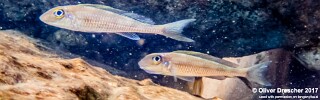
Shallow rocky coastlines with large boulders. Often found in areas with extensive rock formations and clear water.
Geographic distribution:
Endemic to Lake Tanganyika, with an almost lake-wide distribution; an apparent distribution gap exists in the
south-eastern part of the lake.
Typical adult size:
Up to 10 cm; maximum total length of about 11 cm reported.
Sexual dimorphism:
No clear visual differences between sexes; males may grow slightly larger.
Recommended aquarium size:
400 L
Aquarium setup:
Best kept in a group of 6–10 individuals. Keeping too few specimens can lead to increased aggression. Pairs will form
within the group and may separate from it. For multiple pairs, an aquarium length of at least 150 cm is recommended
to allow sufficient territorial space.
The substrate should consist of fine sand, with several large rocks scattered across the bottom and piled higher
toward the back of the aquarium.
Diet:
Herbivorous. Feeds primarily on aufwuchs (biocover) grazing algae from rocks. When plankton is available, it may also
feed in large groups in open water.
Breeding:
Biparental mouthbrooder. A pair separates from the group and establishes a small territory. Eggs are fertilized while
still on the substrate. If the female cannot collect all eggs, the male may assist by picking up the remainder.
Typically, the female broods the eggs initially and transfers the brood to the male around day 8–10. Both parents guard
the fry after release.
Aggression:
Generally peaceful; pairs may become aggressive when defending a breeding territory.
Special notes:
Sometimes proposed to belong to the genus Xenotilapia, but differs in several key aspects, including diet
(herbivorous, whereas Xenotilapia species are carnivorous). Superficially resembles
Xenotilapia sp. “papilio sunflower”, but shows different coloration and a more elongated body.





The substrate should consist of fine sand, with several large rocks scattered across the bottom and piled higher toward the back of the aquarium.
Photo gallery