tanganyika.si

Lake Tanganyika cichlids — species, locations & maps

Lake Tanganyika cichlids — species, locations & maps
By genera By locations Locations Maps Posters Interactive map
Altolamprologus calvus 'Black Congo'.jpg Altolamprologus calvus 'Black Pectoral'.jpg Altolamprologus calvus 'Cape Chaitika'.jpg
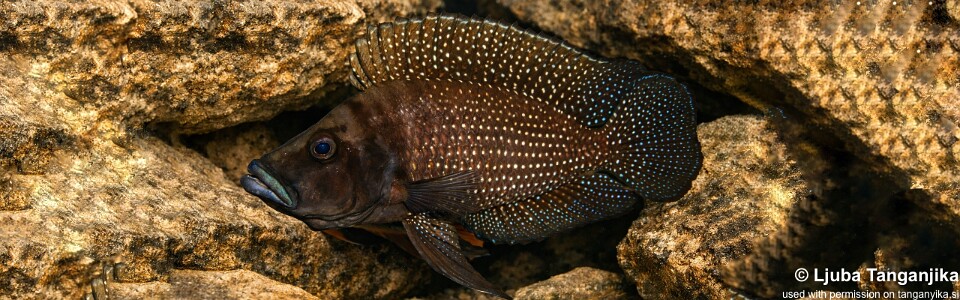
Next pageAltolamprologus calvus (Black Congo)
Tribe / Genus: Lamprologini / Altolamprologus
Type locality: Chipimbi, southwestern coast of Lake Tanganyika (Zambia).
Biotope: Rocky shoreline habitat. Typically found at depths of about 1–15 m. Often occurs sympatrically with Altolamprologus compressiceps (and sometimes A. fasciatus) in the same rocky zones.
Geographic distribution: Endemic to Lake Tanganyika. Restricted mainly to the southwestern part of the lake, between Tembwe (DR Congo) and Kapemba (Zambia). Several geographic variants are known, commonly grouped into three major types: “black” (Tembwe to Cape Kachese), “yellow” (Nkamba Bay area), and “white” (Chaitika to Kapemba).
Typical adult size: Typically up to about 13.5–15 cm total length; females remain noticeably smaller (often up to ~9 cm).
Sexual dimorphism: Apart from the clear size difference, there are no major visual differences between sexes.
Recommended aquarium size: 200 L
Aquarium setup: Provide plenty of rocks arranged to create caves and narrow crevices. For breeding, include caves/cracks with very narrow entrances that allow the female to enter but exclude the male.
Suitable tankmates are other sufficiently large Tanganyikan cichlids such as Cyprichromis, Neolamprologus, Julidochromis, etc. Avoid keeping them with robust, highly competitive species such as Tropheus or Petrochromis.
Best kept as a single pair, or (in a large enough aquarium) a group of at least 7 individuals. A tight-fitting lid is recommended as they may jump.
Diet: Carnivorous predator. Feeds mainly on crustaceans/invertebrates and cichlid fry. Its extremely laterally compressed body allows it to hunt within very narrow rock crevices. In crowded community tanks it may also steal eggs—including from mouthbrooders—snatching them before the female can collect them.
Breeding: Substrate spawner. The male forms only a weak pair bond with females; outside the breeding season he is often found alone.
The female chooses a tight cave or rock crack that only she can enter. She lays roughly 50–200 eggs inside. The male fertilizes them from outside by releasing milt into the cave entrance.
Larvae hatch after about 3 days and become free-swimming after 5–7 days; at that point they can be fed newly-hatched Artemia. The female cares for eggs and fry; the male guards the area near the cave but often disappears before the fry are free-swimming.
Aggression: Generally peaceful; males may be aggressive toward each other. Being a predator, it will opportunistically eat any fry it can catch.
Special notes: Slow-growing, becoming more impressive with size.

Often confused with Altolamprologus compressiceps, but differs by having a longer snout, a less deep body profile, and an absence of scales on the head.

Photo: © Dennis Breuner
Photo: © Enzo Marino
Photo: © Gregor Bauer
Photo: © Ljuba Tanganjika
Photo: © Pisces Farm
Photo: © Sale Sesetdevet
tanganyika.si
Lake Tanganyika cichlids — species, locations & maps.
All images are used with permission of the authors. Unauthorized use is prohibited.
Quick links
By genera By locations Locations Maps Posters Interactive map
Contact
Email Facebook Instagram
© tanganyika.si